
An Interview with ISDP’s Fall 2026 Interns
Every semester, the Institute for Security and Development Policy (ISDP) welcomes university students and recent graduates to take part in its internship program. During their time at the Institute, interns gain hands-on experience in an international environment, work alongside staff on publications, and have the opportunity to develop independent research projects. As they grow into their roles, interns are encouraged to take on increasing levels of responsibility and contribute meaningfully to the Institute’s work. But what does an internship at ISDP actually look like, and what opportunities can students expect along the way?
Our current interns reflect on their first impressions of the Institute and share what they are most looking forward to experiencing during the rest of their internship.
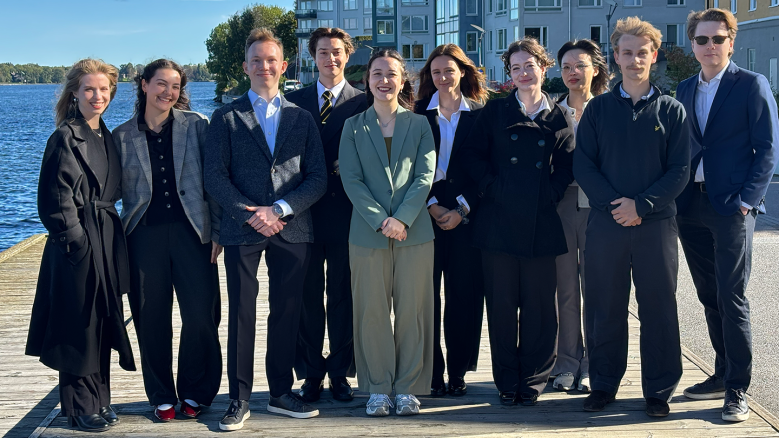
Asia Program: Lisa Bruining; Stockholm China Center: Romane Castel and Julia Marcher; Stockholm Korea Center: Yasmine Neri; Center for Research and Innovation Security: Gustav Bremer; Stockholm Center for South Asian and Indo-Pacific Affairs: Wilhelm Geijer, Hoang An Nguyen, and Joel von Rothkirch; Stockholm Taiwan Center: Haitske Pottinga; Silk Road Studies Program: Caspian Tannerfors
ISDP: To give interested students an idea – what do you work with as an intern at ISDP? And how do you like it?
Caspian: “The work usually consists of a series of analytical deep dives into certain events that relate to the region I work in (Central Asia and Caucasus). However, I have also been given the opportunity to assist with social media and communication efforts, and to coordinate with leading researchers to organize webinars and expert takes.”
The two interns at the China Center, Romane and Julia, also worked on a range of tasks:
Romane: “From assisting in finding speakers for a webinar series, to helping contribute to the monthly center newsletter and its content, or even slideshows for the marketing of conferences – it’s a large range of tasks and I really like this variety.”
Julia also adds the emphasis on the writing of an independent research contribution.
Haitske: “As an intern at the Taiwan Center, my work is very varied as the center is quite small. I assist with every project, like webinar reports, backgrounders, the preparation of conferences, and much more. I think it’s a great balance between more academic tasks like writing and more practical and networking-oriented tasks.”
The balance of tasks is something that the interns are highlighting; many interns are involved with a bigger upcoming conference.
At the Center for South Asian and Indo-Pacific Affairs, the interns are working in a team with a variety of tasks:
Wilhelm: “The pace of work has been challenging but always manageable and we have a great team that always supports us. I particularly appreciate the wide range of topics we have the opportunity to explore in depth here at the center as well as the level of autonomy and independence that we have in how we want to accomplish our tasks.”
Lisa works with the Asia Program more broadly: “As an intern with the Asia Program, my responsibilities are probably the most varied in terms of content. Planning, proofreading, drafting, and brainstorming for papers and reports on various topics is a big part of my work. Not being limited to one region or topic but being able to explore everything I find interesting is a big plus for me!”
What was your highlight and favorite topic so far?
Joel: “While I’m very much looking forward to publishing a piece of my own writing, one of my highlights so far has been the opportunity to co-author a paper with my supervisor on the China-Myanmar-Bangladesh Corridor (CMBC). I did not expect to be involved in such meaningful and substantive work so early in my internship, which made the experience particularly rewarding.”
Wilhelm: “The most interesting topic for me thus far was working with a factsheet focused on China’s relations to Sri Lanka. This gave me the opportunity to engage with topics that are generally lesser known while also placing Sri Lankan politics and economics in the broader context of different actors that are active in the Indian Ocean.”
An especially appreciates the opportunity for interns to attend lectures alongside more senior team members: “The Brown Bag Lectures with senior researchers at ISDP is my highlight. Their experience and insights have given me a unique perspective to broaden my knowledge of international relations.”
Interns also have the possibility to network and interview experts:
Gustav: “My favorite topic so far was conducting an interview, together with Lisa, with Roy Kamphausen, Special Advisor to the President and Senior Fellow for Chinese Security at The National Bureau of Asian Research (NBR), on Chinese strategic thinking and the People’s Liberation Army (PLA) capability development. Not only is it interesting to get expert insight into this topic, but it is also fascinating to gain a deeper understanding on how innovation is being applied in practice and how it shapes global security as a result.”
Caspian: “I was able to assist with a consulting project – there I got the opportunity to discuss with experts and utilize primary sources to reach conclusions that were essential in establishing policy recommendations.”
Yasmine: “My highlight so far is that I’ve been able to attend different kinds of events, from military and defense focused roundtables and seminars to cultural events like the Korean film festival.”
Haitske: “I have been doing a lot of research on Taiwanese domestic politics so far – I really appreciate this because I wanted to do this internship to research Taiwan more thoroughly.”
Julia and Romane were both involved in the final stages of the EuroHub4Sino project of the China Center:
Julia: “My highlight has been being involved in the EuroHub4Sino project, an online platform for contemporary China research where I worked on validating articles, which allowed me to stay on top of recent developments in China-related security issues. The project’s final conference also gave me insightful perspectives on current China matters.”
How can you apply your theoretical knowledge from university in practice?
ISDP interns often come with a background in International Relations and Political Science, or in Asian and Cultural Studies, and, quite often, a combination of both.
Romane: “Your knowledge from university makes it much easier and quicker to digest information in meetings and when researching a particular topic or person. The people you work with often use concepts and terms that you will be familiar with thanks to your academic studies.”
Joel: “While I had focused on the Indo-Pacific in some of my most recent coursework, it had not been the specific focus of my studies. Nevertheless, the research skills I developed throughout my studies of International Relations, combined with a broader understanding of power structures and key actors in international affairs, provided me with a strong foundation to engage with the work of the Center for South Asian and Indo-Pacific Affairs and quickly adapt to its specific regional focus.”
Wilhelm: “As I have been more focused on security studies than my colleagues, I have been able to contribute with knowledge of specific theoretical concepts relating to security and conflict studies while their respective specializations have allowed them to highlight perspectives which I might have overlooked.”
Julia: “I have a background in linguistics and Chinese studies, where I mainly focused on Chinese language, culture, and history. I believe that my experience in engaging with Chinese source texts and examining China through a broader historical and sociocultural lens will become very useful for my work here.”
Caspian: “My Master’s degree is in Russian and Eurasian studies, working with the Silk Road Studies Program allowed me to apply my knowledge to more contemporary events. I find that the approach I developed during my studies, to critically analyze events and connect them to larger trends in the region, was essential.”
Yasmine and Haitske come from the field of Asian Studies:
Yasmine: “I can see how my existing knowledge on Korean peninsula affairs is really useful for the different research projects at the Korea Center and to navigate this internship.”
Haitske: “I frequently work with topics that I have touched upon in my studies. I am excited to specialize more through this internship at the Taiwan Center.”
What are you looking forward to for the rest of your internship experience?
The interns look forward to publishing their own blog posts, backgrounders, issue briefs, or other publications together with colleagues and participating in events where they can meet researchers in the field.
Yasmine: “I’m really looking forward to the Korea-Nordic Forum, the first such event organized by the Korea Center. The panelists and topics are really interesting and I’m excited to be a part of this event.”
Lisa: “I am looking forward to starting the work on my own blog post, which will be a milestone to finish.”
Gustav: “I look forward to continuing my work at the center, as it has given me great insight into areas I am really interested in. Most importantly though, my colleagues and supervisors at ISDP are fantastic to work with as ISDP fosters an atmosphere of collaboration.”
An: “I cannot wait for the Himalaya Conference and more opportunities to learn from IR scholars within the ISDP network, particularly those working on Indo-Pacific studies. I also hope these experiences can help me further develop my master’s thesis on regional multilaterism.”
Caspian: “Dialogues with my fellow interns and colleagues. Every day, I am presented with well-informed takes, interesting deep dives on topics, and lunch break discussions.”
Julia: “Getting to hone my analytical and writing skills in a think-tank environment, which differs quite a bit from academia, as well as getting to engage directly with experts will be valuable parts of my experience here.”
Thank you for sharing your valuable insights! We at ISDP look forward to continuing to work with you in the coming months.
Are you looking for work experience in the field of international security and development? Now is the time to apply for our spring 2027 internships (Application deadline: November 8, 2026).
Here, you can find more information about our internship program and answers to common questions.