Greenland and Arctic Security: What’s at Stake?
Fatoumata Diallo
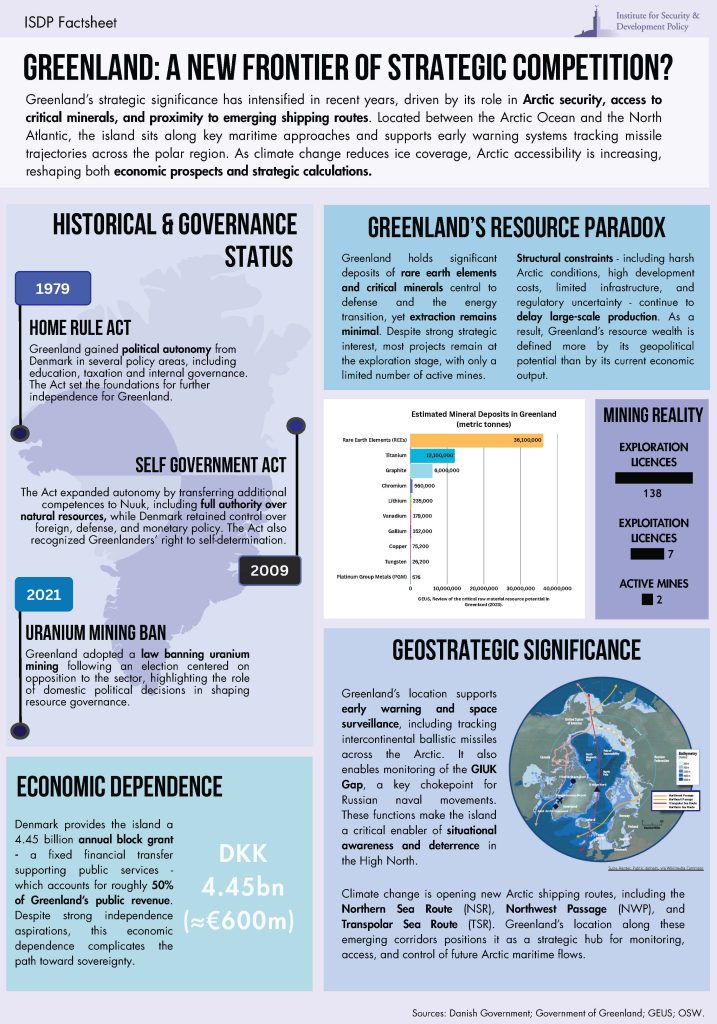
Greenland has emerged as a key focal point in Arctic security, driven by its strategic location between the Arctic and the North Atlantic and its role in missile warning, space surveillance, and monitoring activity across the Greenland-Iceland-UK (GIUK) gap. As climate change increases access to Arctic shipping routes and critical resources, the island’s geostrategic importance is rising, placing it at the center of evolving security and economic dynamics in the High North.
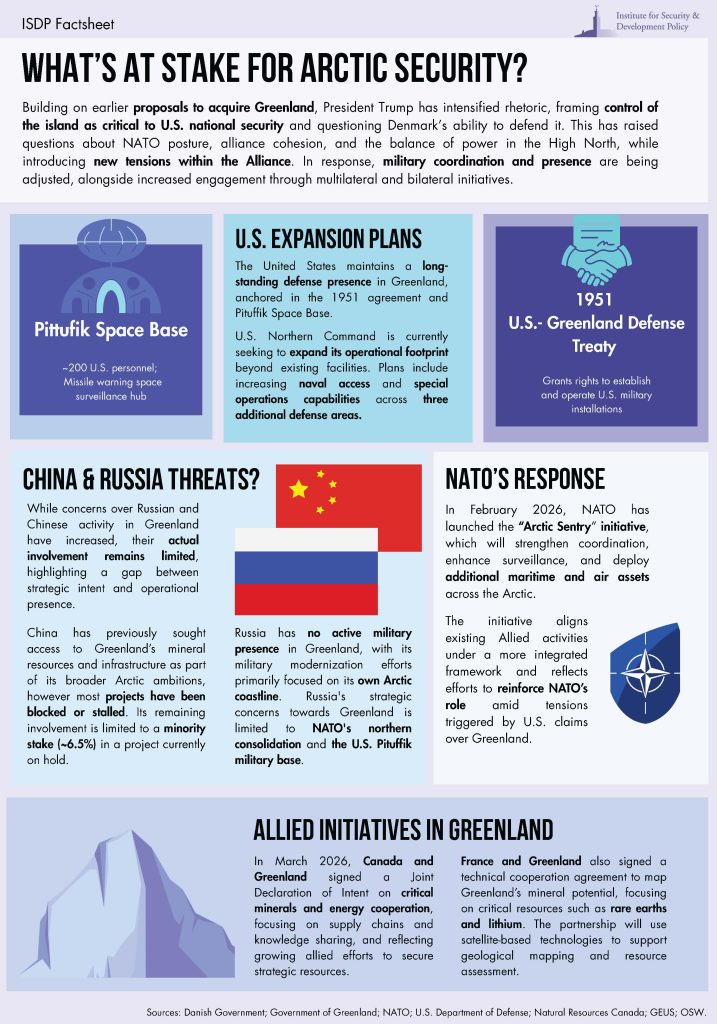
Recent developments highlight intensifying geopolitical competition around Greenland. The United States is seeking to expand its military footprint beyond existing facilities, while renewed political attention – including proposals to acquire the island – has raised questions about sovereignty, alliance cohesion, and NATO’s posture in the Arctic. At the same time, while China and Russia have shown strategic interest in Greenland, their actual involvement remains limited, underscoring a gap between intent and operational presence.
This ISDP factsheet maps key developments shaping Greenland’s role in Arctic security, including its governance status, economic dependence, and resource potential, as well as U.S. expansion plans, NATO’s response, and allied initiatives on critical minerals and energy cooperation. It presents key data and visual insights on emerging Arctic dynamics and highlights the implications for European security, NATO cohesion, and the evolving balance of power in the region.