China’s Maritime and Military Strategy in the Bay of Bengal and the Indian Ocean
J. Mohan Malik
Abstract
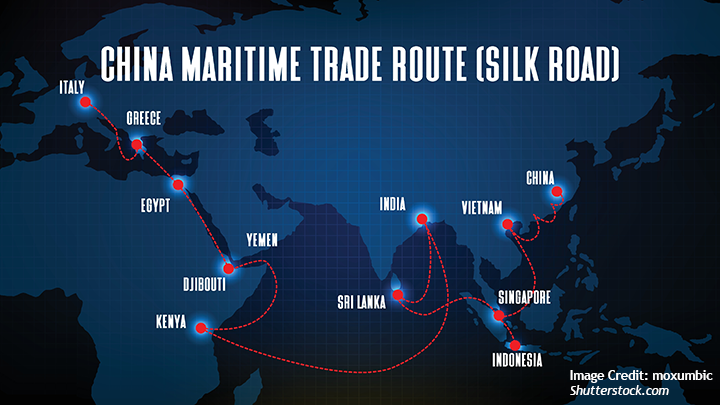
China’s strategy in the Bay of Bengal and the wider Indian Ocean is best understood as an integrated geostrategic, economic, and military project that combines port infrastructure, connectivity corridors, and incremental naval presence. While framed under the Maritime Silk Road, this approach steadily expands China’s capacity to secure sea lanes, project power, and shape the regional order. The Bay of Bengal corridor—linking Thailand, Myanmar, Bangladesh, and Sri Lanka—serves as a critical subsystem connecting the South China Sea to the Arabian Sea and beyond. China’s Indian Ocean strategy has evolved from commercial access to sustaining an operational maritime presence, driven by three factors: (i) China’s growing dependence on energy imports and trade; (ii) the PLA Navy’s “far seas protection” doctrine, which emphasizes safeguarding overseas interests and maritime trade routes; and (iii) a layered engagement strategy that combines commercial infrastructure (ports and logistics), political agreements, and long-term leases for naval access with potential basing rights. This reflects a historical trajectory common to rising powers: commerce generates access, access requires logistics, and logistics ultimately requires military protection. The central argument is that China’s approach is not simply about securing trade routes but about constructing an integrated maritime operating system in which infrastructure, commerce, and military access are mutually reinforcing.
Introduction
The disruption of the Strait of Hormuz during the Iran war has cast a long shadow over another critical maritime chokepoint: the 900-km (550-mile)-long Strait of Malacca which provides the shortest sea route from East Asia to the Middle East and Europe. As the weaponization of strategic sea lanes becomes a feature of geopolitical competition, attention has shifted to the world’s busiest waterway, between Indonesia, Malaysia, and Singapore. At its narrowest point, Malacca is only 2.8 km (1.7 miles) wide, yet it carries nearly a quarter of global maritime trade, including roughly 16 million barrels of oil per day and over 90,000 vessels annually. The narrow and congested waterway has been strategically important to Beijing, with around 65 percent of China’s seaborne crude oil and gas imports passing through it from the Middle East and Africa, while Japan and South Korea depend on it for over 80 percent of their imports. Malacca is the world’s largest “oil transit chokepoint” and the only one that outpaces the Strait of Hormuz. Any disruption—whether accidental, political, or deliberate—would reverberate across global energy markets and supply chains.
Furthermore, all shipping transiting the Strait of Malacca must pass through the Six Degree Channel, a vital sea lane located within India’s Exclusive Economic Zone (EEZ). This gives India a commanding position over the western approaches to one of the world’s most critical maritime chokepoints. While Malaysia, Singapore, and Indonesia dominate the Strait’s immediate littoral, India occupies the broader strategic high ground through the Andaman and Nicobar Islands, particularly Great Nicobar Island, situated barely 40 nautical miles from Malacca’s entrance. New Delhi’s ambitious Great Nicobar Project could significantly alter the strategic balance: plans include a major International Container Transshipment Terminal, a dual-use airport capable of supporting rapid naval and air force deployment, and the strengthening of the Andaman and Nicobar Command as a forward-operating hub. This is not just an infrastructure project but, once completed, will amount to the creation of an “unsinkable aircraft carrier,” extending India’s surveillance, logistics, sea denial, and power-projection capabilities astride China’s critical energy and trade arteries.
In 2003, Chinese leader Hu Jintao coined the “Malacca Dilemma” to describe a harsh reality: China’s economic rise depended on foreign oil passing through a narrow chokepoint that rivals could close in a crisis. For Beijing, this enduring vulnerability lies at the heart of the “Malacca Dilemma”: there is no escape from the tyranny of geography. The alternatives—the Sunda and Lombok Straits—are shallow and hazardous for large tankers and increase transit time and costs. Both routes also pass through Indonesian waters, creating operational and strategic constraints. Recent Indonesian musings about imposing transit tolls—quickly retracted, but nonetheless revealing—underscore a broader lesson drawn from the Strait of Hormuz: once one chokepoint is weaponized, others may not remain immune. The Iran crisis has thus crystallized long-standing Chinese anxieties over maritime chokepoints and raised broader questions about how the Malacca Strait could be affected in the event of conflict in the South China Sea or the Taiwan Strait.
As a result, the eastern Indian Ocean is rapidly emerging as one of the world’s most consequential geopolitical theaters, where disruption at one chokepoint can trigger cascading effects across others. The Bay of Bengal has emerged as a strategic hinge between continental and maritime Asia. For Beijing, it serves as both a gateway and a buffer—providing access to the Indian Ocean, linking South Asia to Southeast Asia, and connecting China’s southwestern hinterland to key maritime routes, while enabling a forward presence along India’s eastern flank. As competition over access, influence, and sea-lane security intensifies, the Bay is shifting from a peripheral waterway to a central arena of regional power politics. Geopolitically, the region remains volatile and unstable. Bangladesh is in political flux, while Myanmar remains mired in civil war. At the same time, major regional powers (China and India) and extra-regional actors (the United States, Pakistan, and Türkiye) are expanding their strategic footprints. The result is an increasingly crowded and competitive maritime domain marked by overlapping spheres of influence, mistrust, and rising geopolitical friction.
This Focus Asia examines China’s expanding naval presence in the Bay of Bengal and the Indian Ocean and its implications for maritime competition and Indo-Pacific power dynamics. It analyzes China’s use of infrastructure, connectivity corridors, and naval modernization to expand its influence, and assesses the constraints and regional implications of this strategy.