Navigating China’s Maritime Silk Road and Economic Coercion
Stephen R. Nagy
Abstract
China’s 21st Century Maritime Silk Road (MSR), the maritime component of the Belt and Road Initiative (BRI), is reshaping global geopolitical and geoeconomic dynamics. While Beijing presents the MSR as a connectivity and infrastructure initiative, this brief argues that it also serves as a strategic instrument for expanding China’s influence, leveraging economic dependence and challenging the United States’ maritime primacy. Drawing on the theoretical frameworks of Rush Doshi, Xu Chenggang, and Wang Huning, it examines the strategic, institutional, and ideological foundations of China’s maritime statecraft. Comparative case studies of Sri Lanka, Pakistan, Malaysia, Djibouti, and Cambodia, illustrate how China employs dual-use infrastructure, elite capture, and asymmetric debt vulnerabilities to achieve its strategic objectives. The brief concludes with policy recommendations for the United States and its allies, emphasizing competitive infrastructure financing, institutional capacity building, debt transparency, and enhanced maritime domain awareness to mitigate the coercive aspects of the MSR.
Introduction: The Strategic Logic and Evolution of the Maritime Silk Road
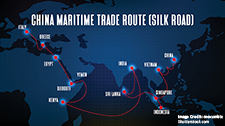
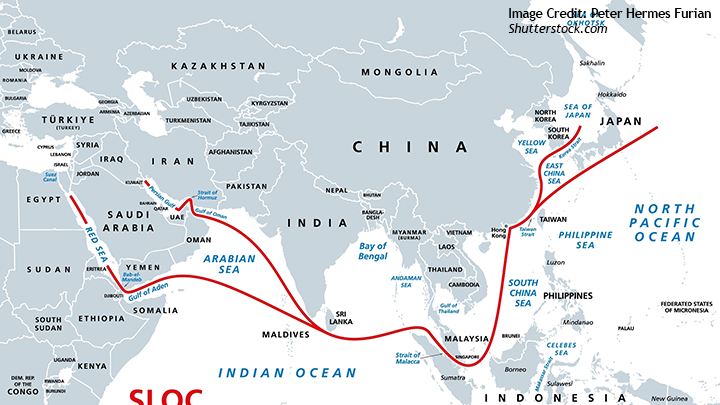
Launched in 2013 by President Xi Jinping during an address to the Indonesian parliament, the 21st-Century Maritime Silk Road invokes the historical legacy of Admiral Zheng He’s voyages to project an image of peaceful trade and cultural exchange. Ostensibly, it is a massive infrastructure and investment project designed to connect China’s coastal provinces with Southeast Asia, South Asia, Africa, the Middle East, and Europe. However, beneath the veneer of “win-win” economic cooperation and the rhetoric of a “Community of Common Destiny” lies a highly calculated grand strategy.
The MSR serves multiple overlapping imperatives for the Chinese Communist Party (CCP). Strategically, it aims to secure vital sea lines of communication (SLOCs) and mitigate China’s “Malacca Dilemma”, its acute vulnerability to a potential naval blockade of the Strait of Malacca, through which the majority of its energy imports flow. Economically, it serves as a spatial fix for exporting domestic industrial overcapacity and securing access to emerging markets.
The MSR can act as a conduit for economic coercion. Economic coercion in this context rarely manifests as overt sanctions, embargoes, or kinetic threats; rather, it operates more subversively through the creation of asymmetric economic interdependence. By financing megaprojects in developing nations—often projects that Western institutions deem too risky or environmentally damaging—China cultivates structural leverage. When recipient states inevitably face debt distress due to the economic unviability of these projects, Beijing can convert its economic leverage into strategic and political concessions. These concessions range from alignment in UN voting and the suppression of anti-CCP rhetoric to the acquisition of dual-use port facilities. Understanding this phenomenon requires looking beyond traditional international relations theories and examining the ideological, institutional, and strategic drivers within the CCP.