‘The more China makes claims of Japanese militarism, the more anti-China sentiment grows within Japan’: An Interview with Professor Kokubun Ryosei
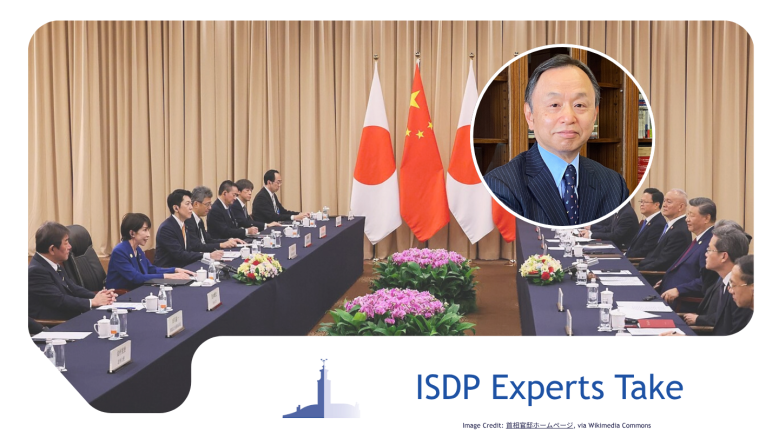
Ryosei Kokubun, Viktor Hellblom, Mathilde Huard and Diana Valeria Nieto Cruz
Introduction
Japan and China bilateral relations are currently facing severe strain. Following remarks by Japanese Prime Minister Sanae Takaichi in November regarding a potential Taiwan contingency, and Beijing’s subsequent accusations of a Japanese “resurgence of militarism”, high-level dialogues and person-to-person exchanges have been canceled, military activity in and around the East China Sea has heightened, and China has implemented export controls on several Japanese companies and institutions. To understand whether this moment represents an unprecedented crisis or a familiar cyclical downturn, this Experts’ Take explores the intersecting historical, economic, and political patterns driving Tokyo and Beijing’s complex relationship today.
To navigate these issues, Viktor Hellbom, Mathilde Huard, and Diana Nieto Cruz sat down with Professor Kokubun Ryosei, a leading authority on Sino-Japanese relations and Chinese domestic and foreign policy. Professor Kokubun is a Professor Emeritus at Keio University, where he served as the Director of the East Asian Institute (1999–2007) and Dean of the Faculty of Law and Politics (2007–2012). Bringing a vital security perspective to his extensive academic expertise, he also served as the President of the National Defense Academy of Japan from 2012 to 2021. The interview was conducted in early June 2026.
A prominent voice in regional diplomacy, Professor Kokubun is the former president of both the Japan Association for Asian Studies and the Japan Association of International Relations. He has edited several foundational works on regional security and diplomacy, including Challenges for China-Japan-US Cooperation (1998), The Rise of China and a Changing East Asian Order (2004), and Sino-Japanese Relations: The Need for Conflict Prevention and Management (2008).