Beijing’s Political Networks: Elite Capture and Party-to-Party Diplomacy in Sri Lanka
Tabita Rosendal
Abstract
Party-to-party diplomacy has become an increasingly important instrument for China’s engagements with the “Global South.” With its geostrategic location and post-default political trajectory, Sri Lanka provides an illuminating example of how small states experience and navigate these party exchanges. At the same time, the Sri Lankan case offers insights into how party-to-party relationships are cultivated and sustained, with lessons resonating beyond South Asia. This issue brief provides an overview of the structure of China’s party diplomacy, the development of Sino-Sri Lankan party exchanges, and the effects of political change on these ties.
Under Xi Jinping, the Chinese Communist Party (CCP) has significantly expanded its international party diplomacy; a strategy that has been part of a broader effort to strengthen China’s political influence, economic interests, and normative presence abroad. Central to this global push is the International Department of the CCP Central Committee (ID-CCP). The department has evolved from a traditional liaison body into a key instrument for advancing the party’s foreign policy interests. This includes championing the “Belt and Road” Initiative (BRI), sharing views on China’s governance and development model, cultivating elite networks, facilitating Beijing’s vision of a “Community of Shared Future for Mankind,” and promoting alternative values. In short, the ID-CCP seeks to build long-term relationships that complement traditional state-to-state diplomacy and reinforce China’s strategic interests abroad.
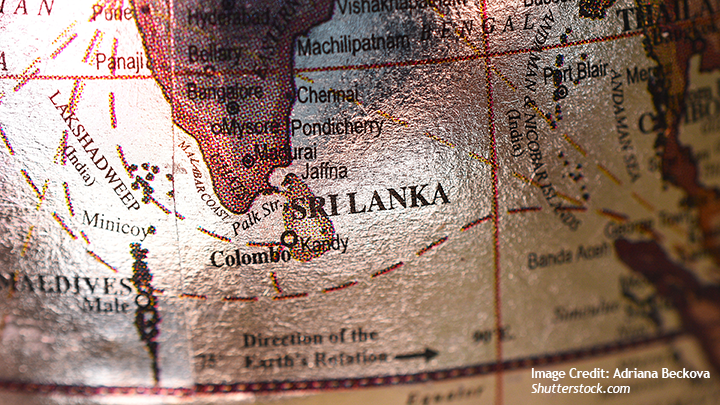
Sri Lanka represents an illustrative case of contemporary Chinese party diplomacy in South Asia. The country’s strategic location in the Indian Ocean, its importance to the BRI, and its evolving domestic political landscape have made it a significant target for CCP outreach. At the same time, Sri Lanka’s democratic backsliding, economic vulnerabilities, and competition among external actors, including China, India, the United States, Japan, and Australia, have created an environment in which political influence is actively contested. Successive governments have generally adhered, at least on paper, to a policy of non-alignment dating back to the Bandaranaike era, while balancing relations with major partners. In practice, however, different administrations have varied in their foreign-policy orientation.
Sino-Sri Lankan party-to-party relations should therefore be understood within the broader context of geopolitical competition, domestic elite bargaining, and Sri Lanka’s longstanding tradition of balancing external powers—even if the latter is not necessarily carried out in a concerted manner. Against this background, this issue brief provides an overview of contemporary Sino-Sri Lankan party relations, their historical roots, and how party diplomacy is conducted. While the case of China’s party diplomacy in Sri Lanka is important in its own right, it resonates beyond South Asia, mirroring cases in developing countries elsewhere—particularly those with colonial pasts.