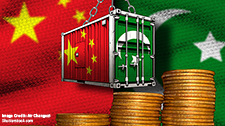
What does China actually think about Sri Lanka?
Anton Harder
Abstract
Discussion of China and Sri Lanka in India and the West is often premised on Beijing’s strategic malevolence, and features phrases like ‘debt-trap diplomacy’ and ‘string of pearls’ to describe a supposed encirclement of India. China’s official language, by contrast, speaks of sincere friendship framed by decades of solidarity and a ‘shared future’. Neither picture survives close contact with more varied Chinese sources. Reading widely in official guidance to Chinese firms, diplomatic statements, and academic and think-tank commentary reveals a plurality of views. This issue brief tries to separate what can be said with confidence from what cannot.
Chinese sources regularly rebut the debt-trap story, but some also suggest something more mundane: a lender that has been cack-handed about debt all along. In 2017, Sri Lanka handed an 80 percent stake in Hambantota port to a Chinese state company, on a 99-year lease, after it could not repay a US$1.3 billion debt. The following year The New York Times declared this a textbook case of ‘debt-trap diplomacy’: China lends more than a country can repay, then claims the asset. Western scholars, notably Deborah Brautigam, have argued that Hambantota does not fit this story. She points out that the port was the Sri Lankan government’s own project and the lease did not cancel out the debt. Colombo used the US$1.1 billion it received to boost its foreign reserves. During Sri Lanka’s later 2022 debt crisis, Liu Zongyi, at a Shanghai think tank, made a related point about the wider picture: China held only ten percent of Sri Lanka’s foreign debt, against roughly 47 percent held by international capital markets, so it could hardly be blamed for the default. Some Chinese scholarship goes further: one 2022 paper, addressing Western criticism that China lends opaquely and negotiates debt relief alone, recommended China be more transparent and consider joining the Paris Club. In light of the Hambantota case, this recommendation points to a different story: China had built no proper mechanism for debt restructuring, so when the loan failed, taking equity in the port was possibly the only answer. A case of poor planning more than premeditated entrapment.
Yet even if China is not setting traps, its conduct on Sri Lanka’s debt is not as multilateral as Beijing likes to suggest. China’s Exim Bank negotiated Sri Lanka’s own debt relief alone, sitting outside the Official Creditor Committee (formed by India, Japan, and other Paris Club members) as an observer rather than a member (the same habit of solo lending that Chinese legal scholars have themselves urged China to address) and reached its own agreement in principle in October 2023, weeks ahead of that group. The announcement reportedly caught the other creditors off guard, who then pushed for assurances that Sri Lanka’s Chinese debt would be treated on comparable terms.[vii] Negotiating alone gave China speed and a freer hand, not a harsher outcome for Sri Lanka: its terms ended up much the same size as the main group’s, and no debt was written off in either case. What is striking is how China’s officialdom then described the result. The 2025 Chinese Ministry of Commerce (MOFCOM) guide to firms operating in Sri Lanka, whose technical detail elsewhere dates and separates the two debt settlements precisely, also, in its front-matter summary, merged these together: Sri Lanka was said to have reached, ‘with the Official Creditor Committee and China Eximbank and other major bilateral creditors, a comprehensive $10 billion debt restructuring agreement,’ implying one collective process. The January 2025 Chinese version of the joint government statement by Sri Lanka and the PRC also obscured China’s preference for unilateral negotiation, describing China as set to ‘continue to play a positive role within the IMF and maintain friendly communication with other creditors,’ immediately after referencing the bilateral plan ‘the two sides’ had reached. These texts reveal Beijing’s contradictory desire for both a free hand to negotiate alone and the appearance of multilateral good citizenship.