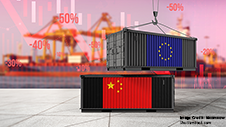
Two Dependencies, Two Logics: Europe’s Economic Exposure to the United States and China
Niklas Swanström
Abstract
A question often raised is how dependent Europe is on the outside world, as if there were a single measure of dependence. There is not. This issue brief shows that Europe’s exposure to the United States (U.S.) and China differs in kind, not merely in degree. Europe’s dependency on the U.S. is concentrated in the financial and security sectors, and is demand-driven, comprising equity co-movement, dollar-denominated earnings, and deep, mutual investment ties that tend to stabilize rather than threaten. In contrast, Europe’s dependency on China is more physical and input-based, centered on rare earths, magnets, pharmaceuticals, solar, and clean-tech; reinforced through state-owned stakes in ports and grids; potentially weaponizable within days; and largely unreduced despite de-risking rhetoric. Two areas complicate Chinese influence in Europe. The first is finance, where U.S. control of the dollar gives sanctions near-global reach, and the second is defense, where U.S. arms dependence carries genuine coercive potential for the EU. Additionally, in one area, technology, European dependency is split: the U.S. leads in the digital layer, China leads in clean-tech, and Europe trails both at the frontier. The brief argues that European policy should prioritize weaponizability over trade volume, manage dependencies together, and make Europe’s response collective.
The starting point of this brief is a distinction that the public debate too often blurs: European dependence on the U.S. and China is not the same. Europe is dependent on both states, but in fundamentally different ways, and conflating the two can lead to misallocated efforts and possibly greater dependency in the long run. The distinction between the U.S. and China is now more important than ever, as a U.S. that is paradoxically more isolationist and aggressive seems to be shifting toward Russia on critical issues, while an ally, at least on paper, is discrediting Europe to a degree not seen before. At the same time, China has weaponized its economy, especially in its dealings with the U.S., with Europe ending up as collateral damage. It is therefore increasingly important to understand what these dependencies entail and how Europe can counter or balance these challenges over time.
The U.S. and China have distinct logics of power that create vulnerabilities for Europe. The United States holds leverage as the hub of the global system, through the depth of its capital markets, the centrality of the dollar, the pull of its consumer market, and the security guarantee on which European defense still rests. Its power is primarily structural, working largely by gravity; it rarely needs to be exercised to be felt. China holds leverage from the other end of the chain, as the indispensable supplier of the materials, processing, and manufacturing that European industry cannot quickly replace. Its power is positional, working through deliberate limitation. The first is broad but slow and diffused, while the second is narrow but concentrated and can be turned on within days. No single political reflex, whether it is “de-risking” or “strategic autonomy,” offers a simple solution to both dependencies simultaneously. This brief therefore explores the two dependencies across trade, supply chains, investment, defense, technology, and money, asking where each genuinely binds Europe and what, realistically, can be done about it, and in what order. This is the first piece of a much longer, more extensive study that compares European dependencies on China, Russia, and the U.S. and attempts to sequence the solutions.
As a brief first takeaway, European dependency on the U.S. is financial and demand-driven, whereas its dependency on China is physical and input-based. Dependence on the U.S. is broad and softening at the margins; dependence on China is narrow, strategic, and readily weaponized. This brief aims to distinguish the two, outline the policy consequences, and offer a few practical solutions to a complex problem that will take decades to rebalance effectively, if it ever succeeds.