Blue Economy, Strategic Seas: China’s Maritime Statecraft in Southeast Asia and Bay of Bengal
Jessica C. Liao
Abstract
This policy brief analyzes China’s evolution into a proactive maritime power, a transition central to its “Great Rejuvenation” and national security. Beyond mitigating the “Malacca Dilemma,” Beijing seeks to establish a stable maritime order aligned with its strategic interests. The research examines a dual-theater strategy that links China’s domestic “Blue Economy” with regional infrastructure development to promote maritime industrial and supply chain integration across Southeast Asia and the Bay of Bengal. While these initiatives expand Beijing’s influence, the intensification of assertive gray-zone activities in disputed waters has also triggered regional counter-balancing. Ultimately, Beijing employs normative rhetoric to position itself not merely as a participant in maritime governance, but as a primary architect of frameworks that institutionalize its influence. Although still in its early stages, this effort signals a long-term intent to formalize a China-led maritime order that could reshape regional waters and beyond.
Introduction
Historically a land-centric continental player, China’s transition into a proactive maritime power is a central tenet of modern Chinese nationalism and its pursuit of world-class status. From the dynastic era through the Republican period, leaders have long viewed maritime capability as the indispensable prerequisite for safeguarding national interests and establishing the stable order required for global commerce. In the modern era, this vision has evolved from a secondary ambition into an existential strategic necessity. Propelled by an inescapable reliance on global trade, post-reform China views maritime stability as the bedrock of its continued growth and prosperity.
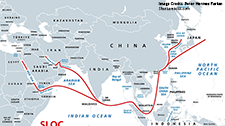
Central to this shift is a critical geographic vulnerability: approximately 80 percent of China’s crude oil imports transit the narrow, highly contested Strait of Malacca. This strategic bottleneck, famously termed the “Malacca Dilemma” by former President Hu Jintao, remains a primary driver of Beijing’s maritime insecurity. While his predecessors identified the problem, President Xi Jinping inherited a China with the financial and military resources to resolve it. Over the past decade, under Xi’s leadership, China has undergone a profound strategic metamorphosis, transitioning from a reactive coastal defender into a dominant, proactive maritime power.
To resolve its strategic vulnerabilities and secure critical supply chains, Beijing has deployed a comprehensive, dual-theater maritime strategy. This issue brief argues that China’s approach relies on a calibrated triad of economic “carrots,” normative rhetoric, and coercive “sticks.” Specifically, Beijing integrates large-scale infrastructure investment and a coordinated maritime diplomacy campaign with the proactive application of coercive tools to achieve deterrence.
The following analysis examines how this strategy has manifested in Southeast Asia—the operational heart of China’s maritime grand strategy and the center of an emerging Sino-centric order. It subsequently compares these developments to Beijing’s westward expansion into the Bay of Bengal, highlighting the distinct strategic logic applied in that theater. Finally, this brief evaluates the empirical results of this dual-theater strategy and considers its broader implications for the regional security architecture.
Evolving Policy Doctrines and the Centrality of Southeast Asia to China’s Maritime Interests
To discuss China’s maritime strategies and related actions, one must first trace the evolution of the high-level policy doctrines that catalyzed them. Under Xi Jinping, the ambition to transform China into a “strong maritime power” (haiyang qiangguo) has been elevated from a peripheral defense contingency to a core pillar of the “Great Rejuvenation of the Chinese Nation.” This paradigm shift has been operationalized through a synchronized overhaul of China’s foreign, domestic, and defense policies.
The foreign policy vanguard of this shift began with the 2013 launch of the 21st Century Maritime Silk Road—the oceanic pillar of the Belt and Road Initiative (BRI). Announced by Xi during his state visit to Indonesia, this initiative leverages physical infrastructure and economic connectivity to project strategic influence. By designating Southeast Asia as the indispensable primary node, Beijing set the stage for deep regional integration across Asia and the Indo Pacific with China at the center.
Integral to this geoeconomic expansion is Beijing’s promotion of the “Blue Economy” (haiyang jingji)—a framework that illustrates how China’s domestic economic imperatives serve as a primary engine for its maritime foreign policy. From the 12th, 13th, and 14th Five-Year Plans, Beijing has consistently prioritized the expansion of maritime space, framing the ocean as the next critical frontier for national wealth and a vital engine of growth. This economic offensive was fortified by a profound reorientation of China’s defense policy. The landmark 2015 China’s Military Strategy White Paper explicitly mandated that the “traditional mentality that land outweighs the sea must be abandoned.” This directive catalyzed the structural transition of the People’s Liberation Army Navy (PLAN) from a localized, reactive doctrine of “offshore waters defense” (jinhai fangyu) to a globalized operational focus on “open seas protection” (yuanhai huwei).
Furthermore, Beijing is working to establish a China-led normative framework to legitimize its new maritime strategy. Since taking office, Xi has pushed for a more proactive Chinese stance in global governance. Thus, the 2019 Defense White Paper introduced the concept of the “Maritime Community with a Shared Future”, which is reinforced by the 14th Five-Year Plan.[ix] This framework guides China’s growing efforts to reshape maritime multilateralism, challenging the long-standing dominance of Western norms and policy discourses.