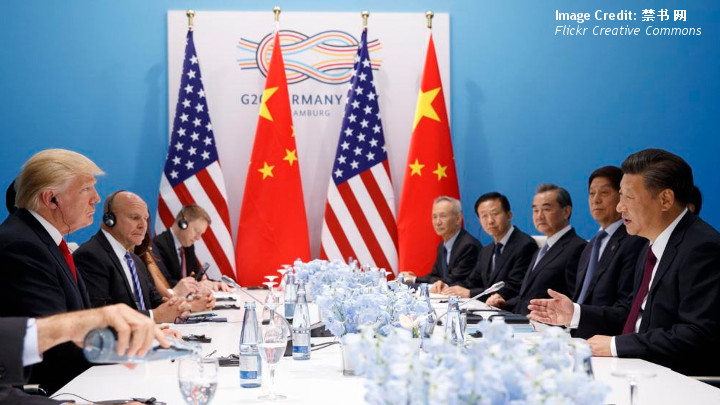
Trump and Xi are playing cards. US and China do not want direct conflict, but will not back down. Andrej Matišák interviews Jagannath Panda in Pravda Daily
Jagannath Panda
-
As the meeting between Donald Trump and Xi Jinping approaches, what do both sides expect from it? What is the main reason for this meeting from the U.S. perspective, and what is it from the Chinese perspective?
For Donald Trump, the forthcoming engagement with Xi Jinping is less about conventional diplomacy and more about strategic bargaining shaped by trade, technology, and geopolitical leverage. Washington’s primary objective is to stabilize competition without surrendering strategic advantage. The United States increasingly views China not merely as a commercial rival but as a systemic challenger capable of reshaping global technology, supply chains, artificial intelligence, maritime security, and even international institutions. Trump would likely seek tactical gains on tariffs, industrial overcapacity, fentanyl flows, and supply-chain dependence while simultaneously projecting American strength to domestic audiences and allies.
From the Chinese perspective, the meeting serves a different strategic purpose. Beijing seeks predictability, strategic breathing space, and above all, the prevention of confrontation with Washington while China consolidates its long-term rise. Xi Jinping’s broader concern is that the United States is gradually constructing a containment framework through export controls, Indo-Pacific alliances, and technology restrictions. Therefore, China hopes to reduce escalation risks, protect access to global markets, and slow down the momentum toward economic decoupling.
The larger context behind this meeting is the transformation of the global order itself. The era of unrestricted globalization is fading and being replaced by competitive interdependence, where economic ties coexist with geopolitical rivalry. Both Washington and Beijing recognize that outright conflict would destabilize global markets, energy routes, and technological ecosystems. Yet neither side is willing to concede strategic ground. The summit, therefore, is less about reconciliation and more about managing a rivalry that increasingly defines global politics.
-
How important is it to manage military and security issues between the U.S. and China in order to avoid a potential conflict?
Managing military and security tensions between the United States and China has become one of the most urgent strategic priorities of the contemporary international system. Unlike the Cold War rivalry between Washington and Moscow, the U.S. and China are deeply interconnected economically while simultaneously competing militarily and technologically. This combination creates both restraint and danger. A crisis in the Taiwan Strait, the South China Sea, cyberspace, or even outer space could escalate rapidly because of miscalculation rather than deliberate intent.
Today’s geopolitical environment is already overstretched by simultaneous crises. The wars in Ukraine and the Middle East have demonstrated how regional conflicts can destabilize energy markets, food security, maritime trade, and global political alignments. A direct and continued confrontation between the world’s two largest economies would be vastly more disruptive. It would shake semiconductor supply chains, global shipping routes, financial systems, and emerging technology sectors worldwide.
This is why military-to-military communication mechanisms, crisis hotlines, and strategic dialogues are critically important. Both sides increasingly operate in close proximity across the Indo-Pacific, particularly around Taiwan and contested maritime zones. Without communication channels, even a naval collision or an aerial incident could spiral into a broader confrontation driven by nationalism and political pressure. China believes the United States is attempting to contain its rise through alliance mechanisms, while Washington increasingly sees Beijing as normalizing coercive behaviour in Asia. The danger lies not simply in military capability but in strategic mistrust. The challenge for both powers is therefore not to eliminate rivalry, which is impossible, but to institutionalize restraint. In an increasingly polarized world order, crisis management itself has become a form of strategic stability.
-
Trump likes to say that countries like Ukraine or Iran “don’t have cards.” What kind of cards does he have when it comes to China? And what cards does Xi have regarding the U.S.?
Donald Trump’s strongest “cards” against China remain America’s structural advantages in finance, military alliances, technology ecosystems, and global market access. Despite recurring debates about American decline, the United States still dominates critical areas such as advanced semiconductor design, dollar-based financial networks, and high-end innovation systems. Washington also possesses a vast alliance architecture stretching from NATO to strategic Indo-Pacific partnerships with Japan, South Korea, Australia, and increasingly India. Trump additionally views tariffs and sanctions as powerful tools of economic coercion capable of pressuring Beijing into selective concessions.
Yet Xi Jinping also holds significant leverage. China has become the manufacturing backbone of the global economy, deeply embedded in industrial production, critical minerals, batteries, renewable technologies, and infrastructure connectivity. While the United States leads in frontier innovation, China controls much of the industrial scale necessary for global production systems. Beijing also understands that many American allies remain economically dependent on Chinese markets and are reluctant to support full-scale decoupling.
Another important Chinese advantage is strategic patience. Beijing believes that time may gradually shift the balance in China’s favour as the international system becomes increasingly multipolar and as domestic polarization weakens long-term strategic coherence in Washington. China also recognizes that the United States is simultaneously distracted by Ukraine, instability in the Middle East, migration pressures, and domestic political divisions.
The deeper problem is that both sides increasingly believe they possess escalation dominance. Trump assumes economic pressure can constrain China’s ambitions, while Xi calculates that the United States cannot indefinitely sustain simultaneous geopolitical confrontations across multiple theatres. Such confidence creates strategic danger because each side risks underestimating the resilience and tolerance threshold of the other.
-
Trump is visiting America’s biggest competitor on the global stage at a time when the U.S. is involved in a war, albeit a paused one, for now. What kind of impact could the Iran war have on the Trump–Xi meeting?
The Iran conflict will cast a significant shadow over any Trump–Xi engagement because it highlights the growing overlap between Middle Eastern instability and great-power competition. For Washington, the crisis exposed the limits of American strategic bandwidth. The United States remains deeply involved in supporting Ukraine, maintaining security commitments in the Middle East, and simultaneously attempting to deter China in the Indo-Pacific. This raises an increasingly uncomfortable question in Washington: Can the U.S. sustainably manage multiple geopolitical theatres at the same time? China is carefully observing these developments. Beijing has attempted to position itself as a relatively cautious actor during the Iran crisis, benefiting from Gulf energy flows while avoiding direct military entanglement. However, the Strait of Hormuz remains critically important for China’s energy security and industrial economy. Any prolonged disruption threatens Chinese growth, maritime trade routes, and broader supply-chain stability.
This dynamic may shape the Trump-Xi talks in several ways. Trump could seek limited Chinese cooperation in stabilizing energy markets or indirectly restraining Iran through diplomatic and economic influence. China maintains important channels with Tehran that Washington lacks. Xi, meanwhile, may use the crisis to reinforce China’s broader narrative that the U.S.-led order generates instability while Beijing presents itself as a comparatively stable and development-oriented power.
At a broader level, the Iran conflict contributes to the perception that American power is increasingly overstretched. Beijing likely calculates that prolonged U.S. engagement in the Middle East creates strategic openings for China across Asia, Africa, and parts of the Global South. Many developing countries now view global politics through the lens of selective intervention, sanctions politics, and double standards. In this sense, the Iran war is not merely a regional crisis affecting the summit; it reflects the wider transition toward a fragmented and contested international order.
-
Many observers say that Trump believes, rightly or wrongly, that he can be friends with Xi and therefore refuses to be truly tough on China. Do you agree or disagree, and why?
There is some truth to this argument, but it oversimplifies Donald Trump’s broader approach toward China. Trump appears to separate personal diplomacy from structural competition. He often believes that strong leader-to-leader relationships can produce better bargaining outcomes than rigid ideological confrontation. This reflects his fundamentally transactional worldview: geopolitical rivals are not necessarily permanent enemies if negotiations and deals remain possible. However, being personally cordial with Xi Jinping does not automatically mean Trump is strategically soft on China. During his earlier presidency, Washington imposed tariffs, intensified technology restrictions, challenged Chinese trade practices, and openly reframed China as America’s principal long-term competitor. In many ways, Trump accelerated the bipartisan consensus in Washington that engagement with China had failed to politically moderate Beijing.
What distinguishes Trump is that he does not always frame competition with China primarily in ideological terms, such as democracy versus authoritarianism. Instead, he tends to interpret rivalry through trade deficits, industrial competition, manufacturing decline, and geopolitical bargaining power. This differs from sections of the American foreign policy establishment that increasingly portray China as a systemic ideological threat. At the same time, Trump’s emphasis on personal chemistry creates strategic ambiguity. Beijing may interpret fluctuating rhetoric as tactical rather than structural, while American allies may worry about inconsistency in U.S. policy. Financial markets also react nervously when foreign policy appears driven by personality rather than institutional predictability. It would not, therefore, be completely wrong to say that Trump’s China policy is softer than it appears to be.
The Slovak version of this interview can be read here.