
Research and Innovation Series (RIS) – Part XII: Australia’s Approach to Research and Innovation Security: Protecting Open Science and International Collaboration
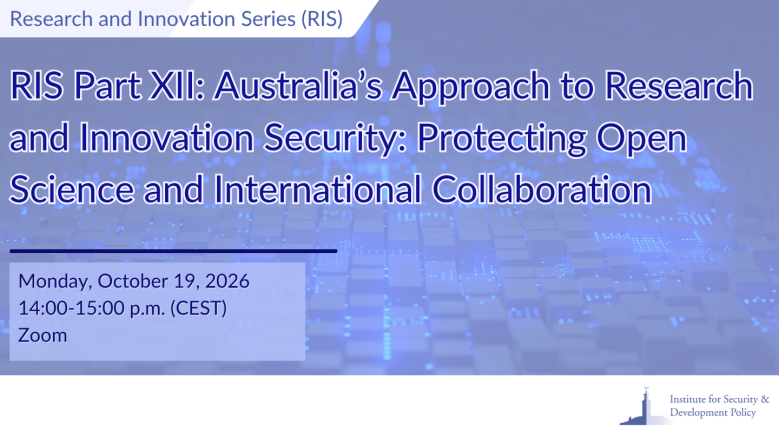
The Institute for Security and Development Policy (ISDP) is pleased to host a new webinar in its Research and Innovation Series (RIS), exploring Australia’s approach to research and innovation security.
Organized by the Stockholm Center for Research and Innovation Security (SCRIS), the webinar series promotes dialogue and exchange of ideas related to research and innovation. By bringing together policymakers, researchers, and practitioners, the series aims to deepen understanding of the policies, government frameworks, and emerging challenges that impact research and innovation security.
Research and innovation are connected to questions of national security and geopolitical competition. As countries seek to advance scientific cooperation and technological development, they are also facing new challenges related to foreign interference, protection of sensitive research, technology transfer, and the security implications of emerging technologies.
Australia has been among the countries actively addressing these challenges, working to strengthen the resilience of its research ecosystem while preserving the openness and international collaboration that drive scientific progress. With Australia becoming an associate member of Horizon Europe, its experience offers important perspectives for Europe as it continues to develop approaches to research and innovation security.
In this webinar, Bart Hogeveen, Senior Fellow – Director Europe, at the Australian Strategic Policy Institute (ASPI), will discuss Australia’s approach to research security, including how policymakers, universities, and research institutions are responding to emerging risks while maintaining productive international partnerships. The discussion will explore key challenges related to foreign interference, dual-use research, critical technologies, and the changing nature of global technology competition.
The webinar will also highlight ASPI’s research tools, including the China Defence Universities Tracker and Critical Technologies Tracker, which are widely used by governments, universities, and researchers in Europe and beyond to better understand research networks, technology trends, and potential risks. Melita Phachulia, Executive Assistant, will moderate the discussion.
The conversation will explore how countries can protect their research ecosystems without undermining academic freedom and international cooperation, and what lessons Australia’s experience can offer to Europe and other like-minded partners seeking to build more resilient innovation systems.
Speaker:
 Bart Hogeveen joined the Australian Strategic Policy Institute (ASPI) in 2017. He’s currently a Senior Fellow and Director Europe. He leads research on technology governance, cyber policy, and foreign interference in research and innovation systems. His work focuses on providing governments and institutions with evidence-based tools to identify strategic opportunities and mitigate security risks arising from international scientific collaboration, with particular attention to China’s global science and technology networks. Bart Hogeveen has contributed to several international research-security initiatives and the development of ASPI’s analytical trackers and databases used by universities and policymakers worldwide.