
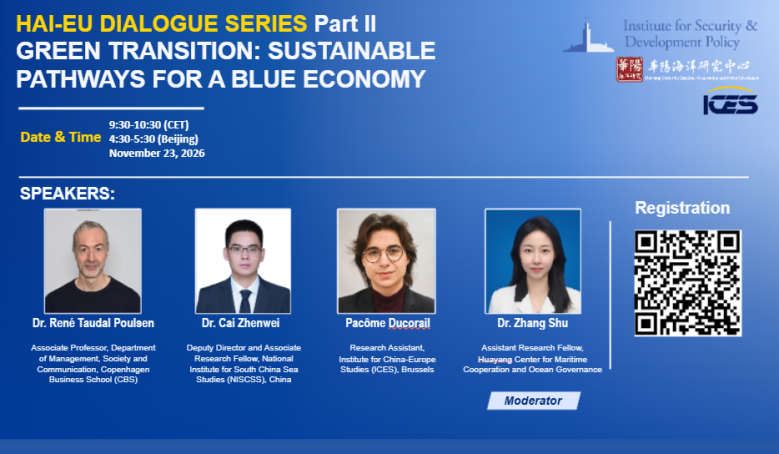
Hai-Eu Dialogue Series – Part II: Green Transition: Sustainable Pathways for a Blue Economy
The transition towards a sustainable blue economy has become an increasingly important priority for maritime development worldwide. As maritime industries continue to grow, balancing economic development with environmental preservation presents both challenges and opportunities. Green shipping corridors, zero-carbon ports, and supportive government policies are emerging as important pathways for reducing environmental impacts while maintaining economic competitiveness.
The second webinar of the Hai-Eu Dialogue Series brings together experts from Europe and China to explore pathways for the maritime sector’s green transition. The discussion will focus on the development of green shipping corridors, pilot projects for zero-carbon ports, and the role of governments in facilitating this transition. Drawing on European and Chinese perspectives, particularly the European Green Deal and China’s Maritime Hainan strategy, the webinar will examine shared priorities, differences in policy approaches, and the challenges and prospects of advancing a greener blue economy.
Speakers:
Dr. René Taudal Poulsen, Associate Professor, Department of Management, Society and Communication, Copenhagen Business School (CBS)
Dr. René Taudal Poulsen is an Associate Professor at Copenhagen Business School, specialising in global environmental governance, political economy and green transitions within the international shipping and port sectors. His research examines how businesses and policymakers can reduce greenhouse gas emissions from shipping, strengthen environmental and labour standards, and advance the sector’s green transition. He also explores questions of global equity, particularly how developing countries can have a stronger voice in shaping international shipping regulations and environmental policies.
Dr. Cai Zhenwei, Deputy Director and Associate Research Fellow, National Institute for South China Sea Studies (NISCSS), China
Dr. Cai Zhenwei is a Research Fellow at the Center for Public Diplomacy and Hainan Openness of the National Institute for South China Sea Studies. He holds a PhD in History from Nanjing University and has long been engaged in research on marine governance, the marine industry and regional maritime cooperation. His research focuses on the marine economy, the Belt and Road Initiative and the South China Sea. His recent work also examines China–ASEAN cooperation on marine governance, including maritime security, sustainable marine development and regional cooperation under frameworks such as the Declaration on the Conduct of Parties in the South China Sea.
Pacôme Ducorail, Research Assistant, Institute for China-Europe Studies (ICES), Brussels.
Pacôme Ducorail is a Research Assistant at ICES. His research interests include China–EU diplomatic relations, strategic narratives, the energy transition and the geopolitics of the Indo-Pacific. He holds a dual Master’s degree in International Relations from Sciences Po Bordeaux and LUISS, as well as an MA in EU International Relations and Diplomacy Studies from the College of Europe. His previous experience includes an internship at the European Commission’s DG INTPA in 2025, where he worked with the South and South-East Asia Team on development cooperation, energy infrastructure and civil society engagement.
Moderator: Dr. Zhang Shu, Assistant Research Fellow, Huayang Center for Maritime Cooperation and Ocean Governance
About the Hai-Eu Dialogue Series
The Hai-Eu Dialogue: Europe–China Perspectives on Ocean Governance and Sustainable Development in the Era of the Hainan Free Trade Port (“海欧”传声:海南自由贸易港时代的中欧海洋治理与可持续发展对话) is a joint initiative of the Stockholm China Center at the Institute for Security and Development Policy (ISDP), the Huayang Center for Maritime Cooperation and Ocean Governance, and the Institute for China-Europe Studies (ICES).
The series provides a Track II platform for dialogue among European and Chinese experts, practitioners, and the wider public, aiming to deepen mutual understanding and explore opportunities for cooperation on maritime governance and sustainable development.