Global Maritime Security Report: 2025-2026 by Huayang Center for Maritime Cooperation and Ocean Governance, China.
Yifei Zhu and Niklas Swanström
Maritime security has become one of the most revealing lenses through which to read the changing strategic environment of the Indo-Pacific and beyond. The maritime domain is no longer shaped by naval capabilities and territorial disputes alone. Coast guards now do work that navies once did, and legal instruments are deployed as readily as ships. As geopolitical competition among major powers intensifies, regional states adjust their strategies and policies in response, developments in one stretch of water carry consequences far beyond a single dispute or subregion.
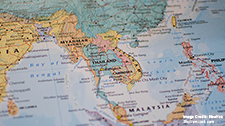
The South China Sea offers a case in point. Here, competing maritime claims intersect with wider strategic rivalries, reshaping the regional maritime order and influencing strategic calculations across the Indo-Pacific and beyond. In recent years, the United States and its allies have expanded their military presence and security involvement in and around the South China Sea. Some European countries have become more active in the Indo-Pacific maritime security, while Australia and Southeast Asian states have adjusted their maritime strategies in line with their respective interests and priorities.
During 2025-2026, the South China Sea has remained generally stable and manageable with regional dialogues and cooperation continuing to advance. Nevertheless, maritime conflicts and disturbances persisted and maritime security risks continued to mount. On the one hand, the growing involvement of extra-regional forces, increasing unilateral actions by some claimants, and the continuing repercussions of the 2016 South China Sea arbitral award, have made these risks more difficult to manage. On the other hand, China and the Association of Southeast Asian Nations (ASEAN) have pressed ahead with consultations on the Code of Conduct in the South China Sea (COC). China has also promoted practical cooperation in the region and pursued ocean governance guided by the vision of building a maritime community with a shared future. These efforts have helped manage differences at sea and sustain peace and stability in the region.
Against this backdrop, the Huayang Center for Maritime Cooperation and Ocean Governance invited nine maritime experts from think tanks in China, the United States, Belgium, Sweden, Australia, Malaysia, Indonesia, and Sri Lanka to contribute to the Global Maritime Security Report 2025-2026. Taking the South China Sea as its starting point, the report examines how developments in the region affect global maritime security and what they mean for ocean governance. Drawing on perspectives from major powers, treaty allies, middle powers, and small coastal states, the report seeks to show how the same strategic environment can be read very differently depending on where one sits.