
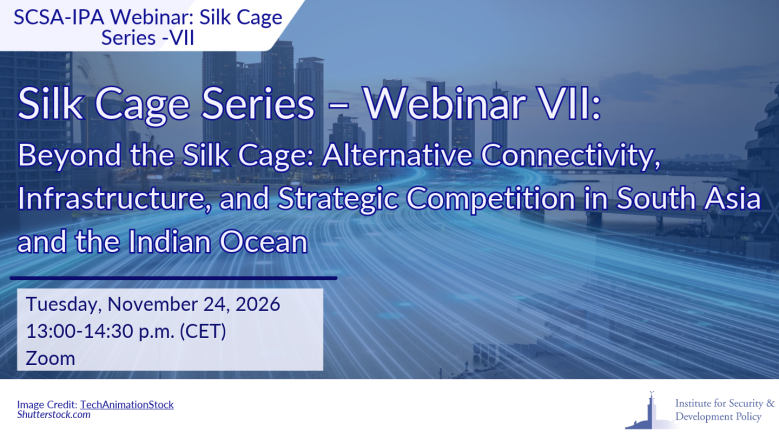
Silk Cage Series – Webinar VII: Beyond the Silk Cage: Alternative Connectivity, Infrastructure, and Strategic Competition in South Asia and the Indian Ocean
China’s expanding economic and strategic footprint across South Asia and the Indian Ocean Region (IOR) has transformed regional connectivity and infrastructure development into an increasingly contested geopolitical domain. Through the Belt and Road Initiative (BRI), Beijing has established an extensive network of ports, transport corridors, energy infrastructure, digital connectivity, and financial partnerships. From the China-Pakistan Economic Corridor (CPEC) and infrastructure investments in Sri Lanka to connectivity projects in Bangladesh, Nepal, Myanmar, and the Maldives, China’s infrastructure diplomacy has generated significant economic opportunities while simultaneously raising concerns about financial dependencies, political leverage, strategic access, and national sovereignty.
Against this backdrop, alternative connectivity and infrastructure initiatives promoted by Japan, India, the European Union, the United States, and other like-minded partners are gaining strategic relevance. These initiatives seek to offer sustainable financing, transparent investment practices, resilient supply chains, and diversified economic partnerships. Yet, their ability to challenge China’s established infrastructure networks remains uncertain. The central question is whether these emerging alternatives can provide credible developmental choices for South Asian countries while reducing excessive strategic dependencies on Beijing.
Japan’s Free and Open Indo-Pacific (FOIP) vision and emphasis on quality infrastructure have positioned Tokyo as an important connectivity partner. Its Bay of Bengal Industrial Growth Belt (BIG-B) initiative, infrastructure cooperation with Bangladesh, and connectivity partnerships with India demonstrate an approach emphasizing economic development, institutional capacity, and long-term sustainability. Similarly, the European Union’s Global Gateway strategy seeks to strengthen sustainable transport, digital connectivity, clean energy, and investment partnerships. The India-Middle East-Europe Economic Corridor (IMEC), alongside emerging regional energy and digital connectivity initiatives, offers opportunities to reshape economic linkages between South Asia, the Middle East, and Europe. However, financing constraints, implementation delays, geopolitical instability, and limited coordination continue to challenge these ambitions.
The United States has also sought to advance alternative infrastructure and connectivity partnerships through the Development Finance Corporation (DFC), the Partnership for Global Infrastructure and Investment (PGII), and strategic cooperation with regional partners. American involvement in Sri Lanka’s Colombo West Container Terminal project and broader maritime infrastructure cooperation illustrates Washington’s interest in strengthening commercial connectivity while addressing China’s growing strategic influence. Nevertheless, shifting American priorities, economic nationalism, and uncertainties surrounding long-term commitments raise questions about the sustainability of these initiatives.
India occupies a particularly important position in this evolving connectivity competition. Its geographical centrality, expanding maritime partnerships, regional development initiatives, and strategic relationships with Japan, Europe, and the United States offer opportunities to shape alternative infrastructure networks. At the same time, India’s neighborhood-first approach, SAGAR vision, and growing engagement with the Global South underline the importance of developing connectivity frameworks that respect regional sovereignty and developmental aspirations. Rather than merely countering China’s BRI, these partnerships must demonstrate their capacity to deliver tangible economic benefits, strengthen regional integration, and create sustainable infrastructure choices.
The seventh webinar of the Silk Cage Series will examine the strategic effectiveness, limitations, and prospects of alternative connectivity and infrastructure initiatives in South Asia and the IOR. It will assess whether competing infrastructure frameworks can reshape regional economic dependencies, strengthen maritime connectivity, and constrain China’s expanding political and strategic leverage. Particular attention will be devoted to the prospects for coordination among major democratic partners, the agency of smaller South Asian states, and the implications for the regional strategic balance through 2035. This webinar, among many other questions, will address the following:
- Can emerging infrastructure and connectivity initiatives provide credible, financially sustainable, and strategically competitive alternatives to China’s BRI across South Asia and the IOR?
- How effective are Japan’s FOIP vision, quality infrastructure investments, and Bay of Bengal connectivity initiatives in addressing China’s growing economic and strategic influence?
- Can the EU’s Global Gateway, IMEC, and associated infrastructure partnerships translate Europe’s economic strengths into a more influential regional connectivity strategy?
- How can US infrastructure financing, maritime connectivity investments, and development partnerships compete with Chinese investments amid shifting American foreign policy priorities?
- Can India emerge as a central coordinating partner for alternative connectivity initiatives while preserving its strategic autonomy and strengthening regional economic integration?
- How can Japan, Europe, the United States, and India coordinate infrastructure investments without creating competing frameworks that undermine the developmental priorities and sovereignty of smaller South Asian states?
- Will alternative connectivity networks meaningfully reduce China’s infrastructure-driven political leverage and strategic influence, or will Beijing retain its structural advantages across South Asia and the Indian Ocean?
Speakers:
 Dr Patryk Kugiel is a chief analyst in the Asia-Pacific Programme at the Polish Institute of International Affairs and an Assistant Professor at the University of Warsaw. His research focuses on South Asia, Indo-Pacific, Global South, global governance and development cooperation. He holds a Ph.D. from the Warsaw University, M.Phil. in South Asia Studies from the Jawaharlal Nehru University in New Delhi and M.A. in International Relations and in Cultural Studies from Jagiellonian University. He is an author of dozens of articles, chapters, and two books: India’s Policy Towards the European Union in the Post-Cold War Era. Partners in the Liberal Order?, Routledge, 2025, and India’s Soft Power: A New Foreign Policy Strategy (Routledge, 2017). He is a frequent commentator on Asian and Global affairs in Polish and international media.
 Genevieve Donnellon-May is an Affiliated Researcher at the Asia Society Policy Institute’s Centre for China Analysis in the China-Russia program and a researcher specializing in regional resource governance (land, food, energy, water) and environmental conflict in Asia, with a focus on China’s role in regional resource competition and cooperation. She holds non-resident fellowships at the Institute for Security and Development Policy (Sweden), the Yokosuka Council on Asia-Pacific Studies (Japan), and a Vasey Fellowship at Pacific Forum (United States). She sits on the advisory boards of Modern Diplomacy and Foreign Policy Talks, and was named a 2023 Young Woman to Watch by Young Australians in International Affairs.
 Dr. Nir Levitan is a Senior researcher and lecturer in International Relations at the Department of Political Studies, Max Stern Yezreel Valley College, Israel. He is a research fellow at the Begin-Sadat Center for Strategic Studies, Bar-Ilan University, and a research affiliate at the Center for Cold War Studies, SDU, Denmark. Dr. Levitan specializes in formal and informal diplomacy in the Middle East and Scandinavia, focusing on negotiation processes, mediation, and alliance-building. His research examines diplomatic practices, regional conflicts and evolving power dynamics through historical and contemporary perspectives. In recent years, he has published extensively on IMEC, exploring its geopolitical significance, regional implications, and future potential.
 Dr Yatana Yamahata is a Japan Society for the Promotion of Science Postdoctoral Fellow at the Center for Southeast Asian Studies, Kyoto University, and a Visiting Fellow at the Stockholm Center for South Asian and Indo-Pacific Affairs, Institute for Security and Development Policy. Her research examines how authoritarianism is reproduced and contested within and across states in Asia, with a particular focus on Myanmar. She is also Editor-in-Chief of 9DASHLINE, an independent digital platform publishing commentary and analysis on issues affecting the Indo-Pacific.
Moderator:
 Dr. Jagannath Panda is the Head of the Stockholm Center for South Asian and Indo-Pacific Affairs (SCSA-IPA) at the Institute for Security and Development Policy (ISDP), Sweden. Dr. Panda is also a Senior Fellow at The Hague Center for Strategic Studies in the Netherlands. As a senior expert on China, East Asia, and Indo-Pacific affairs, Prof. Panda has testified to the US-China Economic and Security Review Commission at the US Congress on ‘China and South Asia’. He is the Series Editor for Routledge Studies on Think Asia.