China’s Regime Influence on Siliguri Corridor States: The Cases of Bangladesh, Bhutan, and Nepal

Antonina Luszczykiewicz-Mendis
Abstract
China’s growing influence in South Asia extends beyond its global maritime ambitions to the political, economic, and strategic dynamics of its immediate neighborhood. This paper examines how Beijing shapes policy choices and political outcomes in Bangladesh, Bhutan, and Nepal, three countries whose geopolitical significance is heightened by their proximity to the strategically vital Siliguri Corridor. It develops an analytical framework encompassing three dimensions of Chinese influence: geopolitical pressure, investment and trade, and cultural and narrative influence. The analysis explores how territorial disputes, gray-zone tactics, military activities, infrastructure development, and upstream water management serve as instruments of strategic leverage. It also assesses the implications of Chinese investment, particularly under the Belt and Road Initiative, for economic dependence and political autonomy. At the ideational level, the paper investigates Beijing’s efforts to promote the term “Xizang” instead of “Tibet” in international discourse, highlighting the relationship between linguistic conventions, sovereignty claims, and asymmetric power relations. Drawing primarily on governmental documents, official statements, media sources, and think tank research, the study focuses on post-COVID developments and situates China’s engagement within the historical context of these countries’ relations with India.
Introduction
The rise of China has long captivated scholars, think tank analysts, and policy experts. In recent years, significant attention has been directed toward China’s global maritime strategy—from the construction of artificial islands in the South China Sea to the expansion of Antarctic research stations. However, developments in China’s immediate territorial boundaries—and the ways in which Beijing exerts influence over neighboring states—are equally critical for understanding the goals and modus operandi of China’s foreign policy.
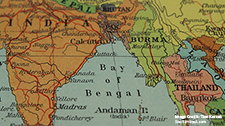
This Focus Asia paper examines how China shapes behavior, decision-making processes, and political outcomes in three countries of the Indian subcontinent: Bangladesh, Bhutan, and Nepal. These states are geographically linked by the Siliguri Corridor: often referred to as a “Chicken’s Neck,” it is a narrow strip of land in West Bengal that connects India’s northeastern states with the rest of the country, making it a critical geopolitical chokepoint.
China’s regime influence in these three countries manifests through multiple channels. To systematize the analysis, this paper adopts a framework encompassing three primary dimensions:
- Geopolitical pressure: Representing the domain of hard power, this category includes the use of unresolved border disputes as leverage and pressure points on neighboring countries through making territorial demands, the employment of gray-zone tactics, and the deployment of military assets under the guise of civilian activities. It also extends to control over critical infrastructure, including both transportation and digital systems. Finally, it encompasses water-related issues stemming from China’s upstream position and its development of water infrastructure.
- Investment and trade: It is a hybrid form of influence combining incentives and coercion against other states. While China provides development opportunities through the Belt and Road Initiative (BRI)—a massive infrastructure and investment strategy launched by President Xi Jinping in 2013, known previously as One Belt One Road (OBOR)—such engagement is often accompanied by accusations of fostering debt dependency and creating so-called “debt traps.”
- Cultural and narrative influence: Situated at the soft power end of the spectrum, this sphere involves subtler forms of pressure, such as cultural events as well as expectations to adopt specific terminology in diplomatic discourse. As the main case study, this paper explores the increasing use of the term “Xizang” in place of “Tibet.” Promoted by Chinese officials since 2023 as a standardized Romanized form in international discourse, this term is framed by Beijing as both an expression of sovereignty and a linguistically justified designation. Critics, however, draw parallels with the colonial practice of renaming territories to assert dominance; moreover, they argue that pressure to adopt such terminology is especially pronounced in countries that are economically dependent on Chinese assistance.
The analysis is based primarily on governmental documents—including agreements, memoranda, and official statements—as well as speeches and articles published in both state and independent media in Bhutan, Bangladesh, China, and Nepal. These sources are complemented by reports and analyses from think tanks and research institutes. As for the timeframe, the analysis focuses on post-COVID developments, which have introduced significant changes in certain aspects of these states’ relations with China.
Furthermore, the paper situates Beijing’s influence within the broader regional context by examining how these three countries’ relationships with China interact with their historically significant ties to India. Finally, it assesses China’s involvement in the 2026 elections in Bangladesh and Nepal as well as their long-term consequences for Beijing’s South Asian outreach.