Chips, Code, and Control: Rewriting the Economics of Old Tech Wars

Abhivardhan and Jagannath Panda
Abstract
Is the emerging global technology order still defined by a single United States–China rivalry, or has that binary narrative already become obsolete? This paper argues that contemporary techno-geopolitics is no longer a unified “tech cold war,” but a fragmented competition across two distinct domains: semiconductors and artificial intelligence ecosystems. The semiconductor contest is shaped by export controls, manufacturing chokepoints, strategic denial, and industrial subsidies. By contrast, AI ecosystems remain more networked and commercially interoperable through data flows, cloud infrastructure, open-source models, and cross-border talent mobility. This paper contends that states misread technological competition when they treat chips and AI as a single geopolitical battlefield. While semiconductor nationalism may intensify hardware decoupling, algorithmic ecosystems are far harder to contain. This divergence is creating a new hierarchy of power shaped not only by fabrication capacity, but also by influence over code, standards, data governance, and platform dependency. It further argues that middle powers, including India, Japan, South Korea, and Singapore, can leverage this fragmentation to pursue technological sovereignty through diversified semiconductor partnerships and sovereign AI governance frameworks.
For nearly a decade, even in a pre-COVID world, the dominant debate in global technology politics was framed in simple terms: the United States leads innovation, China scales manufacturing, and the rest of the world must choose sides. That binary framing is now increasingly outdated. The intensifying competition between Washington and Beijing over semiconductors has not produced a single, unified technological cold war. As Han-Wei Liu and Ching-Fu Lin (2025) posit, this shift represents a move toward “techno-geopolitics,” where the international legal order is being revitalized by the logic of national security. In this environment, the global semiconductor value chain has been weaponized through specific “chokepoint” nodes. These are essential, non-substitutable segments, such as extreme ultraviolet (EUV) lithography and advanced electronic design automation (EDA) tools, where a handful of actors hold the structural power to exclude entire nations from technological progress. This modern pursuit of technological dominance mirrors a much older historical impulse. As Ian Morris (2013) observes, the attempt to measure “war-making capacity” through assessments of relative military power is as old as conflict itself.[iv] Today, however, the “algorithms” for predicting the outcome of future conflicts are no longer found in troop numbers alone, but in the relative strength of a society’s digital and industrial base.
It has therefore generated diverging effects across two connected but increasingly separate domains: chips on one side, and artificial intelligence ecosystems on the other. Semiconductors remain deeply tied to industrial capacity, military modernization, and supply-chain control. AI, however, depends not only on chips but also on data flows, cloud infrastructure, research talent, open-source models, regulation, and trusted partnerships. This distinction matters because while the U.S.-China chip rivalry has become sharper and more restrictive, the global AI ecosystem has become more networked, decentralized, and commercially adaptive.
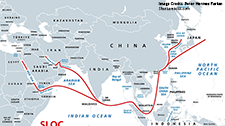
As a result, governments across the Indo-Pacific are no longer responding to a single technological contest. They are increasingly managing two parallel geopolitical realities. One concerns strategic hardware dependency, and the other concerns software power, data governance, and access to frontier AI systems. This shift is creating new diplomatic openings for countries such as India, Japan, South Korea,[vi] Singapore, and other middle powers[vii] across the Global South. The central question today is no longer whether the U.S.-China tech war will divide the world; it is whether the eventual fragmentation of chips and the globalization of AI can create space for new technological sovereignty elsewhere.