Backgrounder: Democratic Struggle and Resilience in South Korea (1948-2026)
Fighting for democracy and political rights, while perpetual by nature, has come back into focus amidst recent global events. Globally, there has been a rise in far-right movements, military coups, state violence, corruption, and political scandals. These developments not only signify a political attempt to return to less democratic regimes but also reflect the importance of protecting political rights now more than ever.
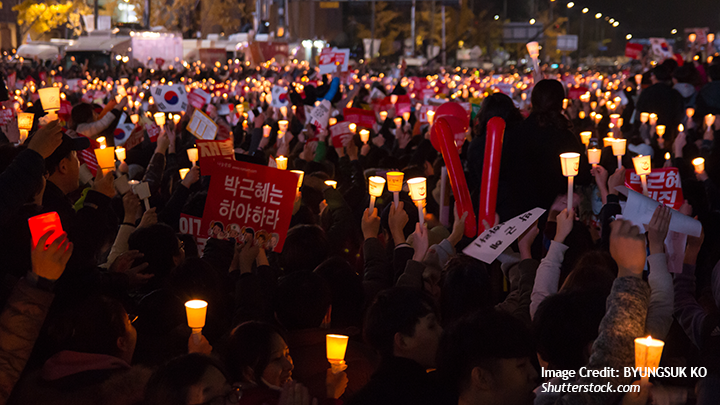
Democratic uprisings build on the people’s will to change and the citizens’ fighting spirit against state oppression, violence, and corruption. The Republic of Korea (commonly known as South Korea)’s fighting spirit reflects a bigger human ideal for democracy; it is an example of constant bottom-up accountability.[i] It is an image of specific cultural traits (which one could argue for or against), but there is no doubt that it prompted a solid movement against authoritarianism and corruption that still maintains a robust stance against political mischief.
Historically subjected to regional powers, Korea is familiar with political power dynamics, both within and outside the continent. Within the region, the peninsula has struggled under the power and influence of the Chinese and Japanese, who have been militarily superior. Outside the continent, Korea has been deeply influenced by the U.S. and Russia (the latter geographically part of the continent but politically tied to the Western hemisphere), which have determined the political direction of the country for the second part of the 20th century. Additionally, South Korea’s contemporary history has been beset by authoritarianism, from Japanese imperial rule to its last dictator, as well as recent attempts to seize political power, such as the martial law declaration by former president Yoon Suk Yeol in 2024.
This backgrounder aims to provide an overview of South Korea’s continuous struggle for democracy and political accountability from 1948 until the present day. It is intended to present concise contextual groundwork and does not aspire to present a comprehensive historical analysis. The scope is deliberately narrow, tracing a linear narrative focused exclusively on the agency of South Korean citizens—their sustained struggle, collective action, and fight for democracy. Consequently, this particular background piece does not examine other significant forces that influenced the country’s trajectory toward democracy and sustained efforts for political accountability, such as the role of religious institutions, foreign aid, international pressure, or economic factors. Instead, it offers a focused walk along the arc of citizen will, culminating in an examination of modern examples where this civic agency manifests in holding politicians accountable. This also allows for future research or background pieces to delve deeper into other forces that influenced South Korea’s road to democracy.
[i] “South Korea,” Transparency International, 2023, https://www.transparency.org/en/countries/south-korea.
(Read the full backgrounder by downloading the PDF)