
Russia-Taiwan relations: From bilateral trade to limited interactions with an “unfriendly state”
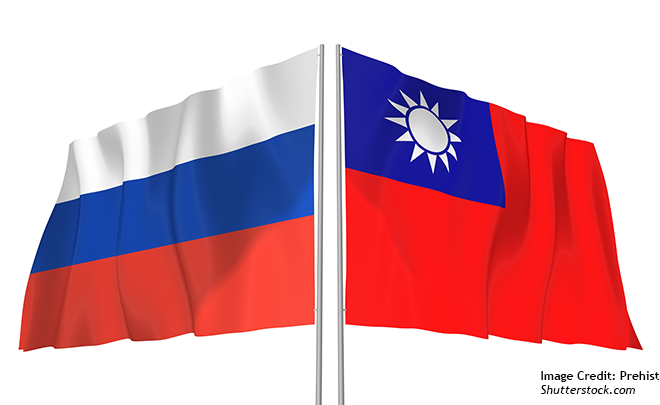
Against the backdrop of the comprehensive strategic partnership forming between Russia and China and Russia’s ongoing war in Ukraine, it is hard to argue that there is any kind of international contacts between Russia and Taiwan. Nowadays, Russia firmly adheres to the “One China” policy, recognizing Taiwan as an integral part of China and maintaining no official interstate relations with Taiwan. However, this state of affairs has not always been the case. While Russia-Taiwan relations have never been a priority for both sides, the two nevertheless maintained a certain level of interaction, ranging from meetings between high-ranking delegations to the establishment of visa-free travel. Despite the rapid deterioration of Russia-Taiwan relations after the Russian invasion of Ukraine, these relations are far from being completely abandoned even today.
Establishment of status quo and first interactions
Russia-Taiwan relations have a relatively short but dynamic history. After the collapse of the USSR in 1991, which had officially recognized the government of the PRC as the legitimate representative of China, Russia officially replaced the Soviet Union on the international arena. As early as September 1992, the first President of the Russian Federation Boris Yeltsin signed the decree “On Relations between the Russian Federation and Taiwan,” which currently serves as the legal basis for the development of relations between the Russian Federation and Taiwan. The decree established unofficial relations between Russia and Taiwan, to be maintained through Russian individual citizens and non-governmental organizations.
It also served as a legal basis for the establishment of Taiwanese representative offices in Russia in 1993 (the Taipei-Moscow Economic and Cultural Coordination Commission) and in Taiwan in 1996 (the Moscow-Taipei Coordination Commission on Economic and Cultural Cooperation). These representative offices function not only as cultural and economic coordination commissions tasked with facilitating cultural exchanges, developing economic and trade relations, and providing information and reference services, but also provide an unofficial channel for communication between Russia and Taiwan without contradicting Russia’s official position on Taiwan’s political and legal status. This form of interaction ensured that Russia-Taiwan relations were conducted solely through non-governmental organizations, private enterprises, and trade associations, thus maintaining the unofficial nature of bilateral contacts. The establishment of a legal basis for Russia-Taiwan relations paved the way for regular economic cooperation, starting with the opening of Taiwan External Trade Development Council (TAITRA) office in Moscow, which boosted trade between Russia and Taiwan. The intensification of trade relations led to the opening of a direct maritime service between Russia and Taiwan in the late 1990s, as well as the ratification of an agreement establishing direct air service between the two countries.
At the same time, Russia-Taiwan political relations took the form of exchanges of official delegations. The most noteworthy examples include a meeting between Taipei mayor Chen Shui-bian and Saint Petersburg Deputy Mayor Vladimir Putin in Russia in December 1995, before either of them was elected president, and a meeting between Taiwan President Lee Teng-hui and a delegation of Russian parliamentarians led by Vladimir Zhirinovsky, leader of the Liberal Democratic Party of Russia.
Development of economic and cultural relations
The beginning of the 21st century was marked by changes of leadership in both Taiwan and Russia. Vladimir Putin assumed the Russian presidency, while in Taiwan, Chen Shui-bian, the candidate of the Democratic Progressive Party (DPP) won the 2000 Taiwanese presidential election, ending more than half a century of Kuomintang rule. The newly elected Taiwanese government focused on strengthening cooperation with Russia. In July 2002, the Taiwan-Russia Association, a non-profit organization dedicated to promoting economic, technological, and cultural ties, was established in Taipei. That same year, a protocol on cooperation between small and medium-sized enterprises of the Russian Federation and Taiwan was signed.
Nevertheless, any prospects for the development of political relations were effectively put to an end by the “Treaty of Good-Neighborliness, Friendship, and Cooperation between the Russian Federation and the People’s Republic of China,” signed in 2001, under which Moscow reaffirmed its support for China on the Taiwan issue. Russia’s commitment to the “One China” policy, however, did not impact the development of Russia-Taiwan economic relations. Russia’s trade turnover with Taiwan kept growing despite a slight decline following the 2008 global financial crisis and reached its peak in 2014 at $4.96 billion. The major Russian exports to Taiwan included iron and steel, non-ferrous metals, mineral fuels and oils, chemicals, fertilizers, paper, wood, rubber and precious stones and metals, while Taiwan’s leading exports to Russia included consumer electronics, electrical equipment and components, plastics, optical and medical instruments, toys and perfumery.
This intensive growth in Russia-Taiwan trade relations began to stall after the Russian annexation of Crimea in 2014, followed by war in Donbas. The impact of Western sanctions together with Russia’s subsequent “pivot to the East” policy—which demanded greater political alignment with China as well as intensification of China-Russia economic relations—heavily contributed to a decrease in trade volume between Russia and Taiwan. By 2018, bilateral trade had generally adapted to the sanctions and, boosted by increased Russian exports, grown to $5.38 billion. In 2021, it reached $6.33 billion, the highest level since the establishment of Russia-Taiwan trade relations. The same year, in September, the Taiwanese government introduced visa-free entry for Russians until the end of July 2019, a measure that was subsequently extended for another year. However, despite growing trade, both sides pursued different foreign policies: while Taiwan continued to rely on the U.S. and the EU against the backdrop of China’s growing military threat, Russia accelerated its move towards closer rapprochement with China, with the aim of establishing a strategic partnership.
Shift from neutral to unfriendly, yet economic interactions persist
The Russian invasion of Ukraine in 2022 led to a rapid deterioration of Russia’s relations with Taiwan. Immediately after the invasion, the Taiwanese government strongly condemned Russia’s violation of Ukraine’s territorial integrity, announced its participation in international economic sanctions against Russia, and suspended visa-free travel to the country. In response, Russia added Taiwan to its list of foreign states and territories taking unfriendly acts against Russia.
Taiwanese sanctions restricted the export of high-tech dual-use goods, such as integrated circuits, chips and electronics, to Russia. In particular, Taiwanese semiconductor manufacturer TSMC refused to continue its cooperation with Russian company Baikal Electronics in producing Baikal-S processors. Taiwan expanded these sanctions in January and December 2023, further tightening controls on the export of semiconductor manufacturing equipment as well as certain chemicals and medicines to Russia and Belarus.
These sanctions, however, did not stop Russia from bypassing them by obtaining Taiwanese machine tools through third countries, with Turkey and China serving as the main transit points. On the other hand, Taiwan continued to import Russian fossil fuels for power generation. From the beginning of the Russian invasion of Ukraine through the end of May 2024, Taiwan imported $6.6 billion worth of Russian fossil fuels with coal making up $3.5 billion of the total. This made Taiwan the fifth-largest importer of Russian coal and increased its dependence on this Russian commodity. In 2025, Taiwan became the world’s largest importer of Russian naphtha, a fossil fuel derivative used in the semiconductor industry, importing $1.3 billion of the commodity.
Conclusion
The Russia-Ukraine war has affected Russia-Taiwan relations, resulting in significant decline in trade turnover. Nevertheless, Taiwan’s dependence on fossil fuels on the one hand, as well as Russia’s need for manufacturing high-tech components for military purposes on the other, provide a basis for both sides to maintain trade relations. Both the Taipei-Moscow and Moscow-Taipei Coordination Commissions continue to award scholarships to Russian and Taiwanese citizens, respectively, and bilateral trade turnover, despite a decreasing trend, reached $4.63 billion in 2025.
Russia, however, has also attempted to push Chinese narratives in Taiwan. In September 2026, the Russian representative office in Taipei organized a screening of an old Soviet documentary film showing battles between the USSR and Japan during World War II. Taiwanese officials claimed that this event was part of an effort to bolster China’s accusations against Japan of “neo-militarism.” It is also necessary to point out, that in response to media reports on Taiwan’s imports of Russian naphtha, the Taiwanese Ministry of Foreign Affairs claimed that Taiwan’s state-owned enterprises had stopped purchasing Russian fossil fuels in 2023, and expressed its intention to cooperate with the international democratic community to place further restrictions on Russian goods. This state of affairs shows that despite a sharp decline in political relations, both countries are likely to maintain unofficial trade relations, driven by mutual economic interests while continuing to pursue fundamentally different foreign policies.