
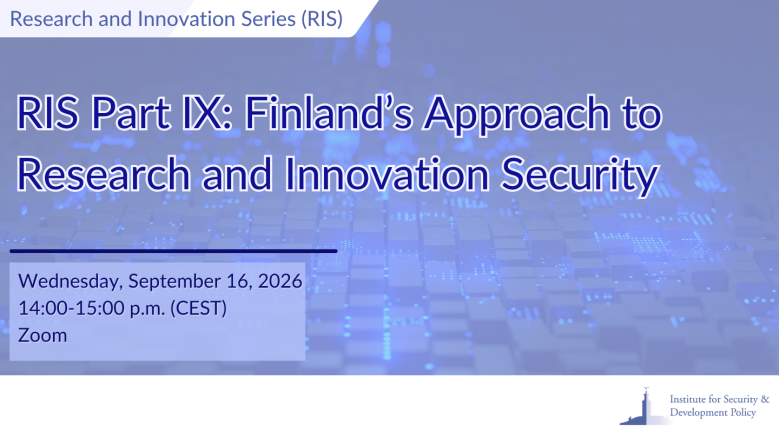
Research and Innovation Series (RIS) – Part IX: Finland’s Approach to Research and Innovation Security
Did you miss this webinar? The recording is available on ISDP’s YouTube channel.
The Institute for Security and Development Policy (ISDP) is pleased to host a new webinar in its Research and Innovation Series (RIS), exploring Finland’s approach to research and innovation security.
Organized by the Stockholm Center for Research and Innovation Security (SCRIS), the webinar series promotes dialogue and exchange of ideas related to research and innovation. By bringing together policymakers, researchers, and practitioners, the series aims to deepen understanding of the policies, government frameworks, and emerging challenges that impact research and innovation security.
Research and innovation have become central to economic competitiveness, national security, and geopolitical influence. At the same time, increasing geopolitical competition, and the growing importance of critical and dual-use technologies have created new challenges for research institutions, including foreign interference, unwanted knowledge transfer, cyber threats, and the protection of intellectual property.
Drawing on Finland’s comprehensive security model, this webinar will examine how government authorities, research organizations, universities, and industry work together to strengthen research resilience while maintaining open and responsible international collaboration. The discussion will also explore Finland’s approach to protecting critical knowledge and emerging technologies and consider lessons for strengthening Nordic and European cooperation on research and innovation security.
The webinar will feature Dr. Katrine Mahlamäki, Special Adviser on Research Security at the Research Council of Finland, and Santtu Lehtinen, Foresight Specialist and Research Scientist at VTT Technical Research Centre of Finland. The speakers will share insights into Finland’s research security framework, practical governance approaches, and the role of key institutions in building a resilient research and innovation ecosystem. Melita Phachulia, Executive Assistant, will moderate the discussion.
Topics will include:
- The development of Finland’s approach to research and innovation security and its key principles,
- The role of research organizations in building awareness and institutional capacity for research security, including the challenge of balancing openness in collaboration with associated security risks,
- Tools, governance mechanisms, and risk assessment practices developed by Finland to strengthen research security, including in relation to critical and emerging technologies,
- Risks to illicit knowledge transfer, including espionage and unwanted technology transfer
- Cooperation among government, research funders, universities, research organizations, and industry,
- Lessons for Nordic and European cooperation on research and innovation security
Speakers:
 Dr. Katrine Mahlamäki, Science Advisor at the Research Council of Finland, is an expert in research security, responsible international collaboration, and the protection of research and innovation. She holds a Doctor of Science (Technology) degree in Computer Science, combining a strong technical background with expertise in science policy and research funding.
Her work focuses on helping researchers identify and mitigate risks associated with international cooperation, emerging technologies, data protection, and knowledge transfer. Katrine is committed to strengthening research security while safeguarding the principles of open science and supporting responsible global scientific collaboration.
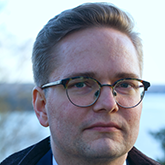 Santtu Lehtinen is a Research Scientist at VTT Technical Research Centre of Finland Ltd. and specializes in STI policy, research security, and strategic intelligence. His most recent work has covered areas such as the geopolitics of technology, dual-use export controls, and Russia’s STI know-how. Lehtinen holds two Master’s Degrees, one in Security and Strategic Intelligence and the other in Contemporary History.
Join us for an engaging discussion on how Finland is strengthening research and innovation security while preserving international scientific collaboration, and what lessons its experience offers for Europe and other like-minded partners.