‘A protracted Ukraine war keeps U.S., Europe distracted while providing PLA cost-free learning’: An Interview with Roy Kamphausen
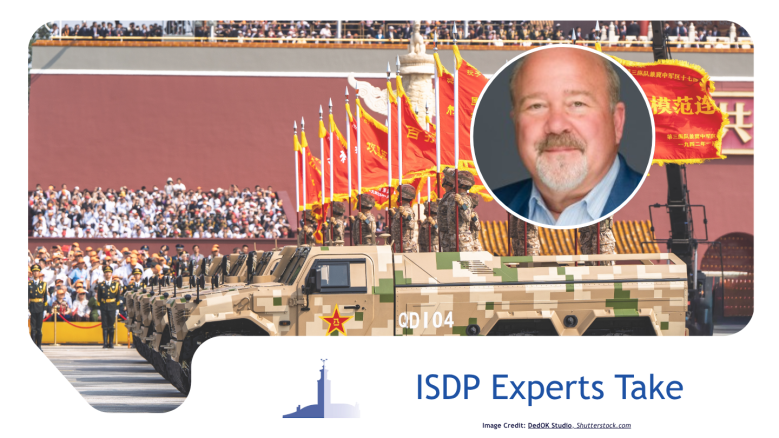
Roy Kamphausen, Lisa Bruining and Gustav Bremer
In this Experts’ Take, conducted by Lisa Bruining and Gustav Bremer from ISDP’s Asia Program and Stockholm Center for Research and Innovation Security (SCRIS), Roy Kamphausen examines how Beijing is reading the war in Ukraine, the conflict in Iran, and the growing strategic competition with the United States and Europe. He also discusses what these developments mean for the Taiwan Strait, the Korean Peninsula, and China’s nuclear expansion.
Mr. Kamphausen is Senior Fellow for Chinese Security at the National Bureau of Asian Research (NBR), where he previously served as president. His career includes serving as China policy director in the Office of the Secretary of Defense under Donald Rumsfeld, Military Attaché to the U.S. Embassy in Beijing, and as China policy chief for the Chairman of the Joint Chiefs of Staff.
He joined ISDP recently for a roundtable on Chinese strategic thinking and the PLA’s growing military capabilities. Following the roundtable, where Mr. Kamphausen discussed China’s concept of Comprehensive National Power (综合国力) and the U.S. “not today” approach of deterring the PLA from acting against Taiwan in the short term, we continued the conversation by asking him for his analysis on Xi Jinping’s relationship with Vladimir Putin and Kim Jong-un, the lessons China draws from the war in Ukraine, Beijing’s gray zone approach toward Taiwan, and the implications of China’s rapid nuclear build-up. In this interview, he argues that a protracted war in Ukraine serves China’s interests, assesses what Beijing is and is not learning from Russia’s performance, and explains why China has proven a limited partner to Iran.