
Roundtable Discussion: India-EU Ties: Tracking Progress in India-Central and Eastern Europe and India-Nordic Relations
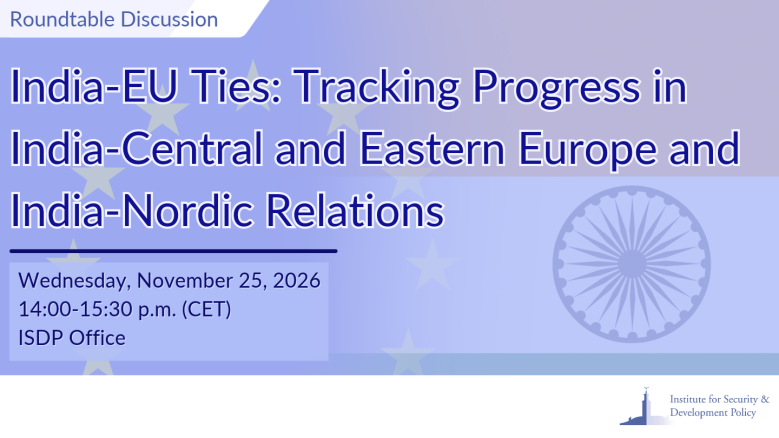
Wednesday 25 November 2026 / 14:00 - 15:30 / By invitation only, limited seats
NACKA ISDP. Västra Finnbodavägen 2, 13130 NACKA. Click here for a map
India–European Union relations are undergoing a significant strategic transformation, driven by changing geopolitical realities, economic diversification, technological competition, and a growing convergence of interests in the Indo-Pacific. As India and the EU seek to deepen their strategic partnership, the relationship is increasingly extending beyond traditional engagements with major Western European powers. Central and Eastern Europe (CEE) and the Nordic countries are emerging as important regional partners in India’s evolving European strategy, offering distinct opportunities for economic, technological, diplomatic, and security cooperation.
The growing significance of India-CEE relations reflects a broader geopolitical realignment across Europe. Countries such as Poland, Czechia, Slovakia, Hungary, and Romania are increasingly exploring stronger partnerships with India, particularly in defense manufacturing, industrial cooperation, digital technologies, connectivity, and supply-chain diversification. India’s expanding economic profile, its strategic autonomy, and its growing importance in the Indo-Pacific make it an attractive partner for CEE countries seeking to diversify their Asian engagements beyond China. Meanwhile, the Russia–Ukraine war has fundamentally reshaped Central and Eastern Europe’s security outlook, creating new opportunities and challenges for India’s diplomatic engagement with the region.
At the same time, India-Nordic relations have acquired greater strategic depth through cooperation in green technologies, clean energy, sustainability, innovation, digital transformation, and advanced manufacturing. Sweden, Finland, Denmark, Norway, and Iceland collectively represent a technologically advanced regional grouping with considerable potential to support India’s economic modernization and green transition. The India-Nordic Summit framework has provided an important political platform for strengthening these relationships. Moreover, Sweden’s and Finland’s accession to NATO has added a new security dimension to India’s engagement with Northern Europe, particularly concerning defense technologies, cybersecurity, and emerging security challenges.
Despite these promising developments, important questions remain regarding the strategic coherence and practical outcomes of India’s engagement with these two European subregions. While CEE countries are increasingly important in European security and industrial politics, the Nordic countries offer established strengths in innovation, sustainability, and high-end technologies. How effectively can India capitalize on these complementary advantages? Can these regional partnerships contribute to a more diversified and resilient India–EU relationship?
Furthermore, the evolving EU approach toward China, Europe’s pursuit of strategic autonomy, and India’s expanding Indo-Pacific partnerships provide an important geopolitical context for evaluating these relationships. The prospects for India-EU trade and investment cooperation, connectivity initiatives, and emerging technology partnerships also raise questions about the roles that CEE and Nordic countries can play in shaping the future of India-EU relations.
Against this backdrop, this roundtable seeks to critically assess the progress, limitations, and future trajectory of India’s engagement with Central and Eastern Europe and the Nordic region. It will examine whether these partnerships remain primarily bilateral and economically driven or are gradually evolving into more substantive strategic relationships that could strengthen India-EU cooperation and contribute to a changing Eurasian and Indo-Pacific order.
This roundtable, among many other things, will explore the following questions:
- How has the India–EU partnership evolved amid changing geopolitical circumstances, and where do CEE and Nordic countries fit within India’s broader European strategic outlook?
- What explains the growing engagement between India and Central and Eastern European countries? How have the Russia–Ukraine war, China’s regional influence, and European security concerns shaped these relationships?
- What tangible progress has been achieved in India’s relations with Nordic countries, particularly in green technologies, digital innovation, defense cooperation, and sustainable development? What are the remaining limitations?
- How do CEE and Nordic perceptions of China influence their engagement with India? Can India’s Indo-Pacific strategy provide a stronger geopolitical foundation for these partnerships?
- How can India and these two European subregions deepen cooperation in critical minerals, semiconductors, resilient supply chains, connectivity, and defense-industrial production?
- Can India–CEE and India–Nordic partnerships emerge as complementary pillars of a stronger India–EU strategic relationship by 2030? What institutional mechanisms and policy priorities are necessary to translate diplomatic engagement into concrete outcomes?
 Speaker: Mr. Matej Šimalčík, Executive Director, Central European Institute of Asian Studies (CEIAS)
 Discussant: Dr Yatana Yamahata, Visiting Fellow, Stockholm Center for South Asian and Indo-Pacific Affairs, ISDP, and Japan Society for the Promotion of Science (JSPS) Postdoctoral Fellow, Center for Southeast Asian Studies, Kyoto University.
 Moderator: Dr. Jagannath Panda, Head, Stockholm Center for South Asian and Indo-Pacific Affairs (SCSA-IPA), Institute for Security and Development Policy (ISDP)