
Panel Discussion: Faultlines and Futures: Trends in China–India Relations
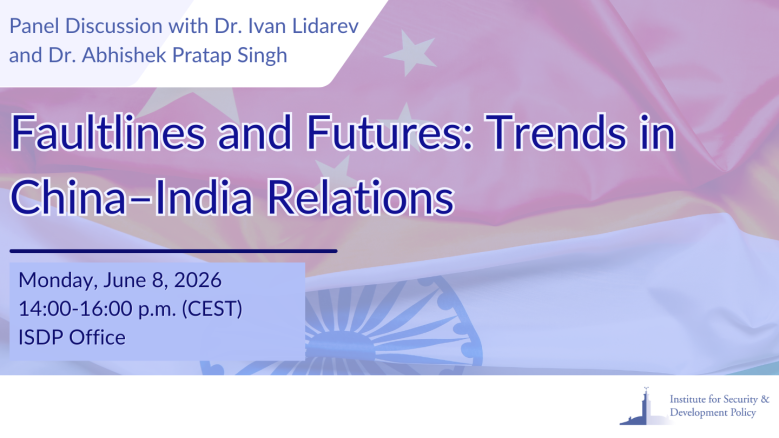
Monday 8 June 2026 / 14:00 - 16:00 / By invitation only, limited seats
Nacka ISDP. Västra Finnbodavägen 2, 12331 Nacka. Click here for a map
China–India relations stand today at a critical crossroads shaped by strategic rivalry, geopolitical uncertainty, economic interdependence, and competing regional visions. As two major Asian powers with expanding global ambitions, Beijing and New Delhi increasingly influence the evolving balance of power in Asia and beyond. Their relationship now extends far beyond the bilateral sphere, carrying implications for the Indo-Pacific order, BRICS+, the Global South, emerging technologies, global supply chains, and multilateral governance. The relationship has experienced a prolonged phase of tension following the border clashes in eastern Ladakh since 2020. While military and diplomatic engagements have helped prevent further escalation, political trust between the two countries remains fragile. At the same time, both China and India are recalibrating their strategic priorities amid intensifying US-China rivalry, regional fragmentation, technological competition, and growing concerns surrounding economic security and strategic resilience. These developments are transforming the nature of China–India interactions from a traditional border-centric dispute into a wider contest over influence, connectivity, technology, and regional leadership. Yet, despite mounting competition, China and India continue to cooperate selectively in several multilateral platforms such as BRICS, SCO, G20, and climate governance frameworks. Trade ties between the two countries remain significant even as debates over dependency, market asymmetry, digital infrastructure, critical minerals, semiconductors, and supply chains deepen. Simultaneously, the maritime domain, the Indian Ocean, and emerging sectors such as artificial intelligence and green technology are adding new strategic layers to the relationship.
Against this backdrop, this panel discussion with Dr. Ivan Lidarev and Dr. Abhishek Pratap Singh seeks to critically assess the changing trends in China–India relations and situate them within broader regional and global transformations. Dr. Jagannath Panda, Head of the Stockholm Center for South Asian and Indo-Pacific Affairs, will moderate the event. The discussion will explore whether the bilateral relationship is entering a phase of long-term strategic competition or whether avenues for coexistence and limited cooperation can still emerge despite deepening mistrust. It will also examine how middle powers, regional institutions, and global geopolitical shifts are shaping the future trajectory of China–India ties. The panel aims to bring together scholars, policymakers, strategic analysts, and regional experts to deliberate on the evolving political, economic, technological, and security dimensions of China–India relations and their wider implications for Asian stability and the emerging international order. Specifically, the panel will explore the following questions:
- What are the key geopolitical and strategic trends shaping China–India relations today?
- Has the post-2020 border crisis fundamentally altered the future trajectory of bilateral ties?
- How are emerging domains such as AI, supply chains, maritime security, and critical technologies reshaping China–India competition?
- Can China and India sustain cooperation in platforms such as BRICS and the SCO despite growing strategic distrust?
Speakers:
 Dr. Ivan Lidarev is a Research Fellow at the Institute of South Asian Studies (ISAS), National University of Singapore (NUS) and Visiting Lecturer at Sofia University “St. Kliment Ohridski”. He specialises in China-India relations and EU-Asia relations. He obtained his PhD from King’s College London and has substantial think-tank experience, having held fellowships at institutions such as Observer Research Foundation (ORF), Institute of International Relations (IIR, Prague), and LSE IDEAS. He also served as advisor at Bulgaria’s National Assembly (2014-2017), Graduate Teaching Assistant at the Defence Academy of the UK (2018-2019), and Associate Features Editor of E-International Relations (2015-2016).
 Dr. Abhishek Pratap Singh has a PhD in Chinese studies from JNU and teaches courses on Global Politics at the Department of Political Science, University of Delhi. He was a Fellow, South Asia Democratic Forum (SADF), Brussels and Visiting Scholar, Centre for India Studies, Shenzhen University. He also attended the Visiting Sinologists Program at Jinan University, Guangzhou, and was an Indian Delegate for the BRICS Program at Fudan University, Shanghai. As a young activist from India, he led the India Youth Delegation to China, Singapore, and Tibet. His works have been published in China Report, India Quarterly, Journal of Defence Studies and other leading publications. Presently, he Heads the Asia Division at VisvaNiti Foundation, a Delhi-based think tank.
Moderator:
 Dr. Jagannath Panda is the Head of the Stockholm Center for South Asian and Indo-Pacific Affairs (SCSA-IPA) at the Institute for Security and Development Policy (ISDP), Sweden. Dr. Panda is also a Senior Fellow at The Hague Center for Strategic Studies in the Netherlands. As a senior expert on China, East Asia, and Indo-Pacific affairs, Prof. Panda has testified to the US-China Economic and Security Review Commission at the US Congress on ‘China and South Asia’. He is the Series Editor for Routledge Studies on Think Asia.