
When Loyalty Becomes Liability: The Fall of Zhang Youxia and Xi’s Grip on the PLA
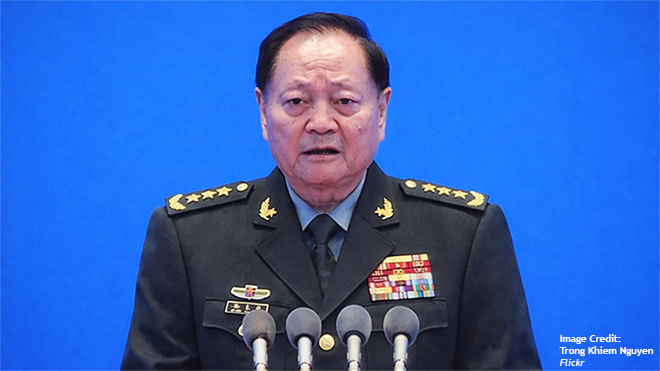
On January 24, 2026, China’s Ministry of National Defense announced that Gen. Zhang Youxia, Vice-Chairman of China’s Central Military Commission (CMC), and Gen. Liu Zhenli, CMC member and Chief of the Joint Staff, had been placed under investigation for “suspected serious violations of discipline and law.” The announcement was exceptional in both timing and rank. As the senior-most uniformed officer, a long-standing pillar of the military leadership, and fellow “princeling”, Zhang’s investigation represents one of the highest level active-duty takedowns in the history of the People’s Liberation Army (PLA).
The case raises fundamental questions about Xi Jinping’s military governance, the state of command discipline within the PLA, and the evolving logic of the anti-corruption campaign at the very top of the Chinese military apparatus – particularly as concerns over combat effectiveness intensify ahead of the PLA’s 2027 centenary.
The Significance of Zhang Youxia’s Removal
Zhang’s case must be understood in the context of a sustained and escalating series of anti-corruption purges inside the PLA, progressively moving toward the highest echelons of command. Earlier purges of former CMC Vice-Chairmen Xu Caihou and Guo Boxiong (2014-2016) set an important precedent, but both cases unfolded after their retirement, allowing the leadership to frame them as retrospective accountability for legacy corruption.
By contrast, the current wave indirectly targets serving members of the CMC, disrupting the active command structure itself. This shift became particularly visible after 2023, when investigations- initially focused on procurement-related corruption within the CMC Equipment Development Department and the PLA Rocket Force- began to expand both in scope and rank. The removal of Wei Fenghe and Li Shangfu, both former defense ministers and CMC members, was followed by action against Miao Hua, Head of CMC Political Work Department, and He Weidong, a serving CMC vice-chairman, removed during the 20th Party Congress in October 2025.
Zhang Youxia’s political pedigree amplifies the significance of this case. A seasoned military officer and one of the few generals with firsthand combat experience from the 1979 Vietnam war, Zhang also served as first-ranking vice-chairman of the CMC and was a member of the Politburo. As the son of revolutionary leader Zhang Zongxun, he belongs to the second-generation reds (hong er dai), placing him in the same political lineage as Xi Jinping. He was widely viewed as one of Xi’s most trusted allies within the military system, making his fall particularly consequential.
Political Disloyalty Reframed as Anti-Corruption
Rather than conventional graft, the accusations articulated against Zhang in the January 25 PLA Daily editorial point to conduct judged to have undermined, diluted, or bypassed central authority. Compared to statements issued against previously indicted CMC members, the language is notably harsher. Zhang and Liu are notably accused of not merely “undermining,” but having “seriously trampled upon” the CMC chairman responsibility system – the institutional mechanism through which Xi exercises personal command over the PLA.
This rhetorical shift signals that the case is framed less as financial corruption and more as a breach of command discipline and political loyalty at the highest level. The warning that “no matter how many people are involved or how deep the implications run, they will be investigated” reinforces this interpretation, reaffirming that rank, seniority, or proximity to the central leadership offers no immunity when command discipline is deemed compromised.
Editorials concerning He Weidong – Miao Hua, and Zhang Youxia – Liu Zhenli similarly accuse the individuals involved of causing “immense damage to the military’s political building and political ecology”. However, in Zhang and Liu’s case, the charges go further, explicitly citing harm to “combat effectiveness construction.” This addition is critical. It introduces an operational dimension absent from previous indictments, suggesting that the alleged misconduct was viewed not only as politically corrosive but also as materially detrimental to military readiness and force development.
With 2027 approaching – marking both the PLA’s centenary and a key milestone in Xi’s military modernization agenda – any perceived shortcomings in readiness carry heightened political and strategic sensitivity. Speculation in Western media, including claims that Zhang may have leaked sensitive nuclear-related data to the U.S., remains unsubstantiated and appears inconsistent with both his political status and the official framing of the case. The language of the editorial more plausibly suggests political judgement rather than espionage. It points to shortcomings in implementing Xi’s centrally defined timelines, or questions about their execution, potentially through informal decision-making or gaps in reporting that may have contributed to operational delays.
Implications for Military Command, Modernization, and Taiwan
Beyond the PLA centenary, the timing of Zhang Youxia’s removal aligns closely with preparations for the 21st Party Congress, where major leadership reshuffling is expected. Xi appears to be accelerating efforts to consolidate control over the military and reshape the CMC ahead of this political milestone.
In the presence of unresolved disagreements or signs of disloyalty, removing Zhang – a peer-level figure with significant informal influence – would be strategically coherent in this context. Even if he had been expected to retire at the next Party Congress, figures of his stature traditionally retain residual authority and informal networks within the party and the military. Acting early reduces the risk of an alternative power center forming within the CMC during a sensitive political transition, even when the individual involved is a long-standing ally.
Whether Xi is laying the groundwork for an extended tenure or shaping the conditions for a future leadership succession, the removal of a heavyweight such as Zhang fragments authority at the top and reinforces the primacy of centralized decision-making. A weakened or reshuffled CMC reduces the scope for collective resistance or informal consensus-building, while easing pressure on Xi to accommodate competing centers of influence.
With Zhang Youxia and Liu Zhenli removed, the CMC has effectively been reduced to Xi Jinping and Zhang Shengmin, the latter recently elevated by Xi to replace He Weidong as second-ranking vice-chairman. This choice is revealing. Unlike many senior commanders, Zhang Shengmin’s career has been rooted in discipline and political supervision rather than operational command. He played a prominent role in earlier anti-corruption investigations, including those involving Xu Caihou and Guo Boxiong. While many officers at the time showed reluctance to probe senior officers, Zhang was known for persisting with disciplinary investigations that pointed toward so-called “tigers”. Since 2017, he has also served as deputy secretary of the Central Commission for Discipline Inspection and Secretary of the CCDI-CMC – influential roles in which he has been directly involved in recent graft purges, including those affecting the Rocket Force. For Xi, this signals reliability in dismantling entrenched networks and enforcing discipline.
Looking ahead, replacements are likely to favor younger officers with limited independent power bases and strong incentives to demonstrate loyalty to Xi and adherence to central directives. While this may enhance political and ideological control in the short term, it carries trade-offs. An environment in which senior officers are reluctant to offer professional judgment that diverges from Xi’s strategic vision – or to flag problems that might be interpreted as obstruction – risks narrowing feedback loops and constraining decision quality.
At present, there is little indication that Xi is in a hurry to fully refill senior CMC posts. This leadership vacuum has raised questions about operational readiness and Taiwan contingencies. Yet, command reshuffling may introduce short-term uncertainty, it does not signal a reassessment of timeliness regarding Taiwan. If anything, the emerging leadership configuration may reduce institutional caution rather than reinforce it. The absence of combat-experienced senior officers, combined with the elevation of politically reliable figures, could encourage greater risk-taking in execution.
This interpretation is reinforced by recent PLA behavior. The January 17 drone incursion into Taiwanese-administered airspace over Pratas island – widely assessed as unprecedented in recent decades- signals continuity, and potential intensification of pressure tactics toward Taiwan, despite disruption at the top of the command structure.
Ultimately, the fall of Zhang Youxia underscores that the current phase of PLA restructuring is driven less by corruption than by the enforcement of centralized political authority at the highest level of command. While leadership turnover may generate short-term frictions, the prevailing trajectory points toward continuity- and potentially higher risk tolerance- in China’s military posture toward Taiwan rather than restraint.