After the Handshake: What Putin’s India Visit Signals to a Fractured World

Jagannath Panda
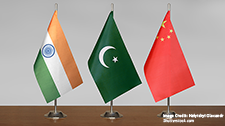
Russian President Vladimir Putin’s visit to India on December 4th and 5th, his first in three and a half years, delivered a striking political message at a time when the world is struggling to re-establish balance. With overlapping wars, intensifying tariff politics, and great-power rivalries fragmenting the global order, Putin’s arrival in New Delhi became an international news event. It was not merely a bilateral engagement; it was a carefully calibrated strategic signal.
In a way, the global system today is neither comfortably multipolar nor predictably bipolar. It is fractured, fluid, and fiercely contested. Against this backdrop, Putin’s presence in India reaffirmed that legacy partnerships retain geopolitical relevance even as states recalibrate their strategies in an age of strategic volatility. Yet the visit also raises a wider analytical debate. Can India sustain meaningful ties with Russia without intensifying strategic friction with the United States and Europe? And what does Moscow’s renewed outreach to New Delhi imply for China’s growing influence over Russia?
Continuity Without Illusions
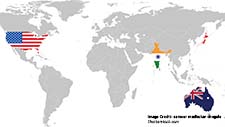
The joint statement that followed the meeting was deliberate but understated. It did not romanticise the partnership, nor did it claim that India and Russia remain the sentimental allies of the past. Instead, it reaffirmed a sense of continuity anchored in realism. Both sides recognise that the world around them has changed dramatically and that their relationship must evolve in response. India’s foreign policy has become more globally diversified than ever before, marked by substantial engagement with the United States – despite Donald Trump’s tariff pressure – as well as with Europe, Japan, and Australia. Russia, in parallel, has been pushed into a deeper-than-desired strategic embrace with China due to Western sanctions.
Despite these structural shifts, Putin’s decision to visit India, at a moment of ongoing conflict in Ukraine, Western suspicion, and India’s rising global profile, was itself a diplomatic signal. By receiving Putin, India did not shy away from acknowledging the geopolitical contradictions surrounding Russia and maintained its concern over peace in Ukraine without public confrontation. Russia, for its part, acknowledged India’s growing role in Asia and its expanding engagement across the Indo-Pacific. This careful choreography confirmed that while India and Russia may no longer be bound by Cold War sentimentality, they remain indispensable to each other’s strategic calculus.
Tariffs, Leverage, and Strategic Autonomy
One under-examined context behind Putin’s visit is India’s strained trade relationship with the United States, particularly President Trump’s escalated tariff measures on Indian goods. These tariffs have created economic uncertainty for New Delhi, raising fears of reduced access to the United States market and placing pressure on India’s export-driven sectors. In this context, a steady relationship with Russia gives India not an economic substitute but crucial diplomatic leverage. First, the visit underscored India’s strategic autonomy. Hosting Putin at a time of tariff disputes with Washington signaled that India rejects the idea that economic pressure can dictate its foreign-policy choices. Rather, India’s foreign policy remains multi-aligned, not subordinated to any one power’s strategic vision.
Second, India’s extensive import of discounted Russian crude oil, now a major pillar of bilateral trade, offers New Delhi macro-economic stability at a time when tariff shocks from Washington could otherwise increase inflationary pressures. Cheap energy strengthens India’s negotiating space, reducing vulnerability to U.S. trade coercion. Third, Russia has shown interest in expanding rupee–ruble trade and investing in joint manufacturing projects that diversify India’s economic partnerships. Even if small in scale, these initiatives send a message: India has alternatives, and tariff pressure will not corner it into concession. Thus, Putin’s visit indirectly strengthened India’s position with Washington. It reminded the Trump administration that India remains a sovereign actor whose global choices cannot be shaped through tariff instruments. For India, the long-standing Russia relationship becomes a stabilising counterweight that helps prevent U.S. economic coercion from escalating into a strategic imbalance.
Energy Ties: Quiet Strength, Low Profile
India-Russia energy ties will likely continue, but with measured public visibility. Several factors drive this emerging low-profile approach. Europe’s concern over Russian revenues remains high, and India is aware that expanding its oil cooperation with Moscow may complicate its FTA negotiations with the European Union. India must therefore calibrate its Russia ties in a manner that preserves goodwill with Europe while ensuring energy security at home.
Furthermore, India’s diversification of suppliers, including the United States, Saudi Arabia, the UAE, West Africa, and Latin America, means that Russia – while essential – will not be allowed to dominate India’s energy mix. The goal is strategic balance, not dependence. India’s long-term participation in Arctic and Far Eastern energy infrastructure-while proceeding slowly under the weight of Western sanctions-continues to hold potential. These investments reflect a future-oriented approach: India sees Russian energy geography as part of its multi-decade diversification strategy. Russia, on its part, is ready to provide an “uninterrupted” supply of fuel to India. Taken together, these dynamics indicate that the India–Russia energy partnership will persist, but in a manner that respects the geopolitical sensitivities of Europe and the United States. The relationship will remain robust, but perhaps less intimidating and discreet.
Messages to Washington and Beijing
Putin’s visit provided India with the opportunity to send two distinct geopolitical messages. To Washington, it underscored that India is a partner-an increasingly important one-but not an ally. India’s deepening defence cooperation with the United States, participation, and engagement in Indo-Pacific strategies do not naturally translate into alignment. Hosting Putin reaffirmed India’s independent strategic identity and reminded Washington that tariff coercion cannot define or shape the partnership. Defence cooperation remains a long-standing yet sensitive element of the relationship. Russia’s assistance in upgrading India’s military platforms continues to offer valuable strategic depth. Russia agreed to encourage joint manufacturing in India of military hardware and spare parts for maintenance of Russian-origin arms and defence equipment. However, over the past decade India has consciously worked to reduce its dependence on Russian systems. This shift toward diversification is both intentional and essential and is indicative of India’s intent to pursue strategic autonomy with a multipolar approach.
To Beijing, the signal was sharper. China has grown accustomed to assuming that Russia, isolated by the West, is firmly within its strategic orbit. Putin’s visit to India disrupts this narrative, demonstrating that Moscow still values New Delhi as a major Asian partner. India, by receiving Putin, signalled to Beijing that it retains meaningful influence in Eurasia and that China cannot monopolize Russia’s geopolitical attention.
The Recalibration in Beijing
A significant but often overlooked outcome of the Putin–Modi engagement is how it compels China to reassess India’s geopolitical weight. For years, China’s strategic community has debated whether India should be treated primarily as a neighbour, with whom China must cooperate, or as a long-term rival likely to align with Western containment strategies. However, Putin’s visit to India forces Beijing to confront a multi-faceted reality.
First, it reveals that Russia – China’s closest major partner in the past three years- still sees India as essential to Eurasian stability. This contradicts Beijing’s belief that Moscow’s strategic reliance on China automatically sidelines India. Second, it signals that India’s influence is rising beyond South Asia. By engaging Putin at this high visibility, India demonstrated that it has the power to shape conversations around Eurasia, BRICS+, and global multipolarity. Beijing must now acknowledge that India wields independent global agency, not merely regional relevance. Third, the visit pressures China to rethink its boundary-centric perception of India. China cannot indefinitely treat India as a future adversary if Russia, its key partner, continues to cultivate New Delhi as a major Asian power. Beijing will be compelled to consider whether sustained rivalry with India is strategically wise, especially as India expands its influence across the Indo-Pacific, the Global South, and emerging technological coalitions.
In this sense, the Putin visit subtly nudges China to see India less as a rival and more as a necessary neighbouring partner, one capable of shaping global debates on technology, climate governance, infrastructure, multipolarity, and Eurasian security. Even if strategic distrust remains, the Chinese calculus must increasingly account for India’s growing global centrality. The visit also subtly revived the trilateral Russia–India–China (RIC) logic. India’s continued engagement with Russia ensures that broader platforms such as BRICS+ and the SCO do not slip entirely into China’s gravitational pull. For Russia, India remains a balancing actor that lends legitimacy to these groupings and helps prevent them from becoming an extension of Beijing’s strategic ambitions.
Conclusions: Multipolarity Reasserted Amid Bipolar Pressures
The Modi–Putin meeting reaffirmed that multipolarity is not rhetorical but operational. For India, multipolarity prevents a U.S.–China–dominated bipolar world from constraining its strategic space. For Russia, multipolarity ensures geopolitical relevance amid Western attempts at isolation. The 23rd annual summit between India and Russia thus reinforced the idea that neither Washington nor Beijing alone can dictate global trajectories. Europe’s response to the visit was predictably ambivalent. On one hand, European capitals remain wary of India’s continued engagement with Russia, given the ongoing conflict in Ukraine. On the other hand, Europe recognises that India is indispensable to its long-term future, whether in supply-chain diversification, technology partnerships, or Indo-Pacific engagement. Europe cannot afford to isolate India, even if it remains uncomfortable with India’s Russia outreach. This duality defines Europe’s evolving strategic view of New Delhi.
In conclusion, Putin’s latest visit to India did not fundamentally reinterpret alliances or reconfigure Eurasian geopolitics. What it accomplished was more subtle but far more consequential: it reaffirmed the resilience of India–Russia ties, strengthened India’s diplomatic leverage amid tariff tensions with Washington, signalled to Beijing that Russia too retains strategic autonomy, and reinforced the relevance of multipolarity at a time when the global system faces dangerous fragmentation. Objectively, the Moscow–New Delhi handshake matters not because it resurrects Cold War nostalgia, but because it reflects the pragmatic strategic logic of two states navigating a fractured world. India and Russia may no longer be natural allies, but they remain necessary partners, shaping, signaling, and stabilising a global landscape in search of equilibrium.
This piece was first published at the ISPI (Italy) on December 9, 2025.