
Meet the Spring 2026 Interns at ISDP
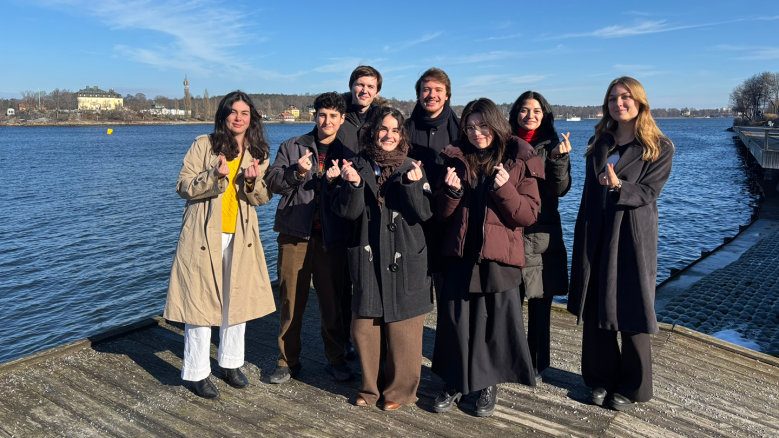
Every semester, the Institute for Security and Development Policy (ISDP) welcomes university students, as well as recent graduates, to join its internship program. During their time at the Institute, interns gain practical experience in a global setting, collaborate with staff on publications or develop their own work, and progressively take on greater responsibilities. What opportunities await students throughout their internship at the Institute?
Our current interns look back on their first impressions of the Institute and share what they are most excited to experience as their internships continue.
Asia Program/ Center for Research and Innovation Security: Mathilde Huard and Bastian Szepanski; Stockholm China Center: Viktor Hellblom and Diana Valeria Nieto Cruz; Stockholm Korea Center: Nerea Alvarez Ariztegui; Stockholm Center for South Asian and Indo-Pacific Affairs: Sevil Khikmatova and Anne Weiler; Stockholm Taiwan Center: Alice Baravelli
ISDP: To give interested students an idea – what do you work with as an intern at ISDP? And how do you like it?
ISDP’s interns usually work with a mix of both research and administrative tasks. They draft newsletters, help with the visuals for publications and social media, monitor the news, and write reports.
Viktor: “At the China Center you are challenged every day, with tasks ranging from preparing background facts and overview of developments on a current affairs topic, designing visuals for social media when there are new publications to summarizing articles to be highlighted in a newsletter.”
Diana adds: “There are the possibilities of participating in webinars and focusing on personal research projects as well. I like the fact that tasks change from week to week and that this has allowed me to learn about different topics and develop new skills.”
The Stockholm Korea Center is regularly welcoming guest researchers. Nerea describes that he is assisting guest researchers in coordinating their residency meetings.
Sevil and Anne were already involved in different events, report writing efforts as well as data collection at the Stockholm Center for South Asian and Indo-Pacific Affairs:
Sevil: “I feel that I am leveling up in both my writing and research skills– gathering data from a variety of sources, including the ones in Chinese and Japanese takes way less time now than before I started the internship.”
“You usually navigate through news and more or less recent publications, which are genuinely a cornerstone for everything you will then be working on,” explains Mathilde who is working with a variety of topics in the Asia Program and Center for Research and Innovation Security.
What does your typical day look like?
Alice: “I usually arrive at the office around 9.00 AM, and the first thing I do is get a cup of tea and then sit at my desk. I check my to-do list for the day, and I try to make the most out of the morning. Once a week, I usually have a meeting with my supervisor to discuss my current and future tasks. Around 12.00, I have lunch with all the interns and have a nice chat together. In the afternoon, I start with less demanding tasks such as news reading and finalize more urgent ones.”
Anne: “My day usually begins at 9:00 AM. I find I’m most productive in the morning, so I dedicate those early hours to deep-focus tasks like research and writing. We then have lunch all together in the office around 12:00The afternoons are more collaborative often filled with meetings involving our center, visiting guests, or ISDP colleagues. I spend the final hours of the day wrapping up my remaining tasks before we all head out together at 5:00 PM.”
“A typical day within the Asia Program doesn’t really exist. As your tasks vary constantly, every day will feel different,” describes Bastian.
The interns work in teams with each other but also within their centers. The tasks and structure of the days can vary from week to week. “Communication is key to a smooth day,” says Mathilde.
What was your highlight and favorite topic to work on so far?
Diana: “The most interesting topic I have worked on so far has been Greenland geostrategic importance. Having read extensively on this topic and collected a lot of data for a Backgrounder publication, I was able to learn about a very actual and relevant topic.”
Anne: “The standout moment for me has definitely been the webinar series on the Chinese Corridor in Pakistan. It’s one of those topics that gets more interesting the deeper you dig; there are just so many layers to uncover.”
Sevil: “I leant a lot about the strategics of China in South Asia, and the role of other great and middle powers in the region – such as India, Pakistan, Bangladesh, and Myanmar.”
Bastian: “My favorite topic so far has been Arctic security; it’s an area we’ve only briefly touched upon in my master’s program.”
On the event side, Alice says: “I think a major highlight will be the Taiwan-Nordic Forum and the webinars and roundtables planned for the next few months!”
Mathilde: “We helped in the organization of the launch of one of ISDP’s booklet called ”The Next Generation 2025/26 – The Future of Korean Research from a Nordic Perspective”. It was a pleasant experience where I had the chance to exchange with the writers as well as with the invitees.”
Nerea: “So far, I have been very lucky with my internship and have worked on many interesting topics. However, I deeply enjoyed working with guest researcher Dr. Hannah June Kim. Her research was very interesting and allowed me to participate in many insightful conversations around gender policies in Korea, Sweden and the conscription system in both countries.”
Viktor: “The highlight so far has been the internal lectures organized by ISDP. We, for example, recently had one where we learned about the think tank writing style, which was extremely helpful for someone used to the academic writing style.”
Many of ISDP’s interns are moving to Sweden for the internship, some cultural highlights are the weekly coffee break with the team, fika, and special days:
Diana: The highlight of my internship so far was Fettisdagen, “Fat Tuesday”. Traditionally people eat Semla on that day and we were surprised with them in the office.”
How can you apply your theoretical knowledge from university in practice?
Sevil: “My university studies equipped me with theoretical framework, how to identify research gaps, use sources, and explore the topic.”
Diana: “Among the other things, during my master I learned how to conduct research in different areas, how to analyze data and how to navigate the East Asian world from a geopolitical perspective. These skills have played a crucial role in my daily activities, helping me navigate complex information in an efficient way.”
Viktor: “Insights from Chinese Studies about China’s political system, such as the level of importance and how different Chinese ministries relate to each other, has been very useful when deciding on what to focus on in the newsgathering and in finding data for the reports we are writing. I have also been able to apply knowledge from my Political Science studies, regularly engaging with core PS concepts such as multi- and bipolar world orders, securitization, and globalization.”
Nerea: “As a master student of War and Defense, my expertise in security matters and research is incredibly helpful when collecting data and interpreting the relevance of the news and other information sources on my daily tasks.”
Bastian: “The program’s security-oriented perspective makes it an ideal match for my Master’s degree. I’ve had the chance to work on several highly relevant topics, and I am finding that this experience is also providing invaluable material for my Master’s thesis.”
What was unexpected?
Bastian: “At the beginning I was really surprised how much the senior staff trust their interns and how open they are for our opinions and perspectives.”
Alice also explains: “I didn’t expect interns to be so involved in everything that is going on at the center, and I really appreciate that we are always taken into consideration when events are planned or center meetings are held.”
Viktor: “A happy surprise about the internship has been how much we interns are included in the work and how much our efforts are recognized. Colleagues at ISDP are very busy, so it has also been unexpected to see all the small acts of kindness that I have been extended, like a team member leaving a book on my desk related to something I asked about the same day. “
Sevil: “I am happy to meet other interns here at ISDP – amazing people, sharing similar interests and generally curious. We often spend the weekends together and this is something I was not expecting.”
Mathilde: “Things move quickly and tasks accumulate fast. ISDP is a project-driven entity, so your tasks can change completely from one day to the other. I find it genuinely driving because you have the opportunity to work on such a wide range of topics. Another unexpected but nice surprise is how easy it is to exchange with everyone at ISDP. And being multiple interns at the same time greatly enhances the experience!”
What are you looking forward to for the rest of your internship experience?
The interns look forward to publishing their own blog posts, backgrounders, issue briefs, or other publications together with colleagues and participating in events where they can meet researchers in the field.
Nerea: “I am looking forward to the next guest researcher, Chun In-Bum. Currently we are preparing for possible meetings that could interest him for his research proposal, and I really want to participate in these meetings and get to know both Korea and the Nordics better through this new perspective.”
Alice: “I am preparing my research backgrounder, and I am really grateful to my supervisor for helping me brainstorm a topic that I am excited to work on.”
Anne: “I have a lot to look forward to in the coming months. Ultimately, I’m excited to continue expanding my knowledge base and connecting with the diverse professionals who visit the institute.”
Sevil: “I am looking forward to writing my backgrounder, a blog post and maybe even some interviews. After starting the work at the Center for South Asian and Indo-Pacific Affairs, I became much more curious in broadening my knowledge about India’s role as a middle power in the South Asian region and learning more about the economic corridors in the Indo-Pacific.”
Thank you for sharing your valuable insights! We at ISDP are excited to continue collaborating with you in the months ahead.
Here, you can find more information about our internship program and answers to common questions.
Right now, ISDP is looking for interns for the fall semester 2026/ 2027.