
Flawed by Design, Structurally Shielded: How Policies to Combat Demographic Pressures Enable Human Trafficking in South Korea
Introduction
Modern security challenges have shown how even in the absence of armed conflict, countries can face significant instability. Among the most pressing of these challenges are demographic decline and aging populations. These trends pose not only economic challenges but, for countries like the Republic of Korea (ROK or South Korea), also create national security and military risks. As the population shrinks and fertility rates continue to decline, South Korea’s largest age group is now between 50 and 64 years old. The nation’s population has been declining steadily since 1984, taking a sharp fall in 2015. While births rose by 6.8 percent in 2025, the country’s fertility rate is still around 0.80, far below the ideal replacement rate of 2.1 children per woman.
Experts have identified specific factors such as policy missteps that have inadvertently driving up housing costs, along with the widespread adoption of smartphones and the rise of social media, which have altered social behavior and consumption patterns in ways that may discourage family formation. However, policymakers continue to rely on measures that prioritize short-term interventions over the structural reforms needed to reverse demographic decline. Recent proposals have focused overwhelmingly on the role of women in increasing the national birthrate. In doing so, they overlook key economic, institutional, cultural and societal constraints that prevent young people from establishing stable families. While these gendered assumptions about responsibility for reversing demographic decline have already undermined South Korea’s efforts to address the crisis, they have also produced unintended consequences, particularly by increasing vulnerabilities to human trafficking. This blog post focuses specifically on human trafficking risks arising from ineffective marriage brokerage systems and gender-focused demographic policies aimed at boosting the national birthrate. It does not address other forms of human trafficking occurring in South Korea or assess the country’s immigration or anti-trafficking frameworks.
From Fighting Demographic Decline to Enabling Human Trafficking
Gendered Domestic Initiatives to Boost the Low Birth Rate
In response to South Korea’s declining fertility rate, policymakers have proposed a series of controversial domestic measures that narrowly position women as the primary solution to the demographic crisis —often at the expense of their safety and autonomy. These include university courses offering dating courses, local “mass blind dates” events, and forcing women’s universities to admit male students in response to declining youth populations.
On a more concerning note, a South Korean think tank suggested “creating a one-year age gap between girls and boys at school so that they would be more attractive to each other by the time they reached marriageable age”—a proposal that ignores girls’ safety and reinforces gender stereotypes, including the assumption that men are inherently attracted to younger women. However, the most striking proposal emerged in 2026, when Jindo County Governor Kim Hee-soo suggested that South Korea should recruit unmarried foreign women to marry rural bachelors.
As extraordinary as this proposal may appear, South Korea has indeed come to rely on foreign women as part of its demographic strategy. A proposal put forward in 2023 sought to allow foreign domestic workers to be paid less than the minimum wage as a means of encouraging higher birthrates among double-income families. Foreigners also play an increasingly important role in the shifting dynamics of demographic intervention, as immigration has become more prevalent globally. The growing “feminization of international migration,” particularly in South Korea, reflects migration patterns linked to cross-border marriage migration. According to a government report, in 2020, approximately 138,000 women entered South Korea as marriage migrants, representing 82 percent of all total marriage migrants and 25 percent of all female migrants. As of 2026, local governments continue to provide financial assistance to South Korean men living in rural areas to facilitate marriages with foreign women. As a result, immigrant wives in Korea are disproportionately concentrated in depopulating rural areas such as South Jeolla and Gangwon Provinces.
Marriage Brokerage System and Increased Vulnerability towards Human Trafficking
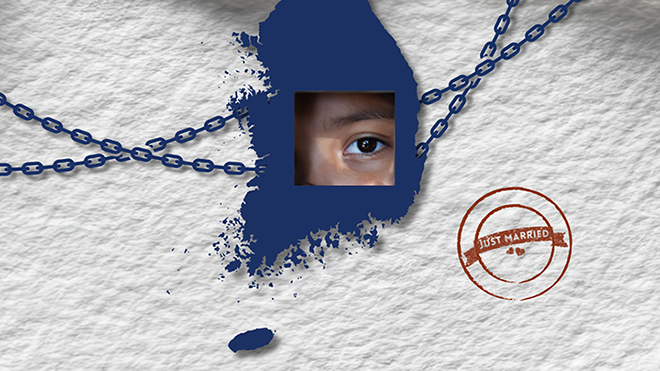
The link between marriage migration and human trafficking in South Korea is structurally embedded within an international marriage brokerage commercial system in which profit incentives override protections. Some international marriage brokers operate under the weakly enforced Marriage Brokers Business Management 2007 Act, charging fees contingent on successful marriages while failing to conduct background checks on Korean sponsors. Driven by profit, these brokers actively portray foreign women—primarily from Vietnam (33.5 percent), China (18.1 percent) and Thailand (13.7percent) of the 19,700 registered foreign marriages reported in 2023— as “docile, submissive and pure”, playing into gendered stereotypes that are supported within Korean traditional expectations. Female marriage migrants are often viewed as commodities and thus left unprotected through the brokerage process.
Once recruited, foreign women become vulnerable to forced labor, sexual exploitation, domestic violence and financial abuse. A survey conducted by the National Human Rights Commission of Korea found that about 68 percent of female marriage immigrants said they had experienced sexual abuse, including being forced to have sex or subjected to sexual humiliation. However, the brokerage system that facilitates their entry faces little or no accountability. Marriage brokerages, therefore, do not merely facilitate migration but actively produce conditions of vulnerability that criminal networks and exploitative spouses can exploit for human trafficking purposes. These risks are most acute for women from Southeast Asia, who are identified in the 2025 US Trafficking in Persons (TIP) report as especially vulnerable because trafficking is already widespread and severely underreported due to conflict, political instability, and weak legal enforcement. Such conditions make these women easy targets for brokers.
Despite South Korea moving from Tier 2 to Tier 1 in 2024 (reflecting its intent to increase efforts to combat TIP) and enforcing the Act on the Prevention of Human Trafficking Prevention in 2023, protection mechanisms for victims are not properly established, and neither are there appropriate systems to investigate related crimes. Human trafficking also remains severely underreported, partly because South Korean law still lacks a comprehensive criminal definition of human trafficking in a manner consistent with international law. This results in a varied understanding of the crime among law enforcement agencies, and the South Korean government tends to prosecute human trafficking crimes under other offenses, such as commercial sex, kidnapping, domestic violence, and other forms of sexual abuse. This makes it difficult to determine which law enforcement actions actually nvolve human trafficking.
This gap between legal ambition and effective protection is not merely a matter of bureaucratic inefficiency, but reflects the broader way in which the demographic crisis has been problematized by policymakers. By framing population decline primarily as a national security threat and treating foreign women as instrumental solutions to rural bachelordom or low birthrates, policymakers have created a permissive environment where exploitation can flourish under the guise of marriage migration and labor supplementation. As a result, the very policies intended to reverse demographic decline risk becoming conduits for trafficking, shielded by institutional neglect and a narrow, gendered conception of who bears responsibility for reproduction.
Policy Recommendations – A Much-Needed Shift in Focus
South Korea’s current approach to its demographic crisis has become self-defeating. By adopting short-term fertility-boosting measures that emphasize women’s reproductive roles and instrumentalize their bodies, policymakers have inadvertently created a regulatory and narrative environment in which human trafficking thrives and foreign women are particularly vulnerable. To reverse the course, it is essential not only reform existing programs but also reshape how the demographic problem is understood and addressed.
Reframing demographic security as a long‑term structural and cultural challenge that invests in local youth and families
The most urgent shift needs to occur in the prevailing mindset that treats demographic decline as an emergency that requires immediate and gendered solutions. Prioritizing speed over sustainability has legitimized unequal and ethically questionable proposals in the name of urgency. Kim Hee-soo’s suggestion to “import” young foreign women is a manifestation of this mindset, favoring short-term fixes over structural reforms.
One strategy would be to invest in work-family reconciliation infrastructure. Long-working hours, limited childcare provision, and workplace cultures that penalize caregiving continue to undermine family formation and disproportionately affect women’s careers. Whilst the 6+6 Parental Leave introduced in 2025 represents a step in the right direction, it is necessary to expand it with enforceable action, alongside substantial investment in public childcare and after-school programs. Additionally, comprehensive measures are needed to stabilize housing and employment for young people, so as to reduce the economic precarity that delays marriage and childbearing.
Centering gender equality as a national security imperative
For demographic policies to achieve their goals, cultural norms must also be challenged. The current policy discourse systematically burdens more than half the population from meaningful decision-making. Policies that focus solely on women’s responsibility to boost the fertility rate reflect a fundamentally flawed diagnosis, ignoring workplace culture, housing affordability, childcare infrastructure, and men’s role in caregiving. In effect, current policies position women as both the cause of and the solution to the demographic decline.
Gender equality should be recognized as a core national security priority. Integrating gender analysis into demographic policymaking, would require would require policymakers to assess the the differential impacts of the proposed measures on men and women, ensuring that efforts to increase fertility do not come at the expense of women’s rights, safety, or autonomy. Sweden offers a useful example within the European Union (EU). Although its fertility rate has also declined, it has consistently remained above the EU average, owing to its gender equality focus combined with income inequality discussions. Understanding how cultural, social, economic, and institutional factors shape reproductive choices across different population groups, would enable policymakers to design more effective and equitable demographic policies.
Rejecting the instrumentalization of foreign women
The use of immigration as a fertility tool reflects the mistaken assumption that migrants can solve population decline. Research from Sweden suggests that while foreign-born women often exhibit elevated fertility rates shortly after arrival, second generation fertility patterns increasingly resemble those of native Swedes. In essence, cross-sectional fertility boosts do not translate into multigenerational demographic stability. The long-term demographic impact of relying on immigration as a fertility tool therefore remains limited, whereas the vulnerabilities its creates can contribute to human trafficking and exploitation. Marriage migration often leaves recruited women vulnerable because of unfamiliarity with local laws, language barriers and dependence on their Korean spouses for their visa status. Further, a 2017 report by the National Human Rights Commission of Korea (NHRCK) found that 42 percent of immigrant spouses had experienced domestic violence.
Conclusion
The demographic crisis in South Korea is both real and urgent. However, its urgency does not justify compromising fundamental human rights or the instrumentalization of women’s bodies—whether Korean or foreign. The path forward requires reaffirming a rights-based approach: only by rejecting the logic that treats human beings as instruments of demographic policy can South Korea create the conditions under which people freely choose to have children and raise families. “Importing” foreign women as a response to demographic pressures will not address the structural causes of South Korea’s low birthrate; instead, it risks perpetuating the very conditions that enable human trafficking and exploitation.