
Gender Polarization among the Youth in South Korea: Predictors, Military Consequences, and Insights from Sweden
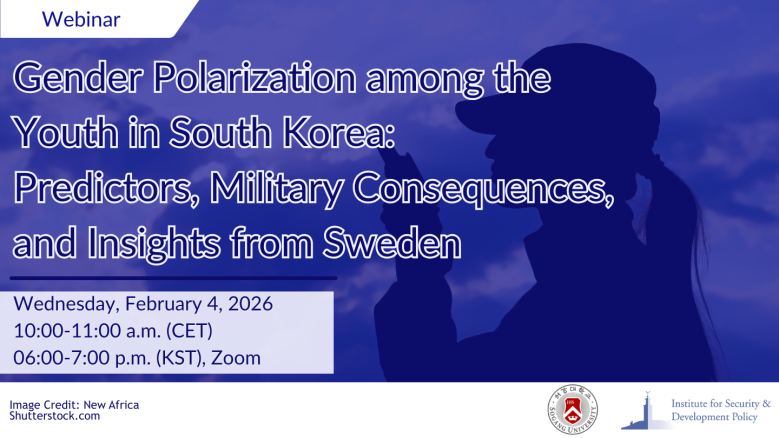
Did you miss this webinar? The recording is available on ISDP’s YouTube channel.
Gender polarization has emerged as one of the most pressing and contentious issues in contemporary Korean society, particularly among younger generations. Public discourse increasingly highlights the divide between young men and women through terms such as idaenam (men in their twenties) and idaenyeo (women in their twenties), reflecting deep-seated differences in perceptions, priorities, and grievances. This polarization has been shaped by a range of structural and cultural factors, including declining employment opportunities, soaring real estate prices, and the pervasive influence of digital media and online communities, all of which have contributed to widening gaps in attitudes and expectations between women and men.
Beyond these contemporary drivers, one longstanding and uniquely Korean factor has been the mandatory military service required of men, which has historically shaped gender roles, social responsibilities, and perceptions of fairness and opportunity. Military service not only reinforces gendered expectations but also contributes to disparities in career trajectories, social mobility, and economic stability between women and men, further exacerbating societal divisions.
This webinar examines the various predictors of gender polarization, with particular attention to the experiences of youth and the social consequences of military obligations. It analyzes both structural and cultural mechanisms that sustain gendered divides in South Korea. In addition, the webinar draws on Sweden’s experience with gender mainstreaming, which has successfully integrated gender perspectives into public policy, education, and labor markets. By exploring Sweden’s model, including inclusive policy design and proactive societal interventions, the discussion considers how lessons from this case can inform practical proposals for mitigating gender polarization in South Korea. Ultimately, this webinar aims to contribute to a deeper understanding of how entrenched gender divisions emerge, persist, and can be addressed through a combination of structural reform and cultural change.
Speaker:
 Dr. Hannah June Kim is an Associate Professor at the Graduate School of International Studies (GSIS) at Sogang University, where she also serves as Director of the Korea and East Asia program. She earned her Ph.D. in Political Science from the University of California, Irvine, and previously held positions as an Assistant Professor at the University of Nebraska Omaha and as a Postdoctoral Scholar at Stanford University’s Walter H. Shorenstein Asia-Pacific Research Center.
Moderator: Josephine Ørgaard Rasmussen, Project Manager, Stockholm Korea Center