
Silk Cage Series – Webinar V: Hormuz in the Silk Cage: China’s Choke Point Strategy by 2030–35
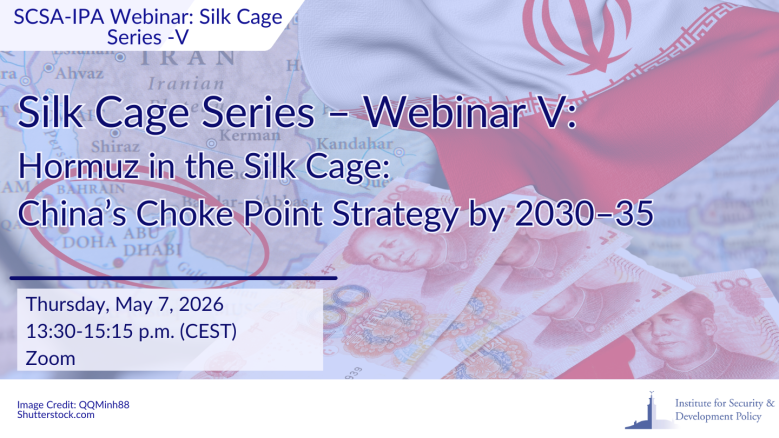
Did you miss this webinar? The recording is available on ISDP’s YouTube channel.
The Strait of Hormuz has traditionally been described as the world’s most important energy chokepoint. A significant share of globally traded oil and liquefied natural gas passes through this narrow maritime corridor each day, linking the Gulf to Asian, European, and global markets. Yet by 2030–35, Hormuz may be defined not only by energy flows but also by strategic competition. The emerging debate is no longer simply whether China depends on the Strait of Hormuz, but whether Beijing is steadily transforming that dependence into long-term geopolitical leverage. As China broadens its commercial reach, maritime footprint, and political influence across the Gulf and the wider Indian Ocean, Hormuz is increasingly becoming part of a larger Chinese strategic architecture.
For China, the Strait of Hormuz is central to economic security. Chinese industrial growth, manufacturing resilience, and domestic energy stability remain closely linked to uninterrupted supplies from Gulf producers. This structural dependence has long created what Chinese strategists often describe as a vulnerability dilemma: how can a major power rely so heavily on sea-lanes that remain influenced by others, particularly the United States and its naval partners? Beijing’s answer has not been direct confrontation, but gradual positioning. Through the Maritime Silk Road, China has invested in ports, industrial zones, logistics hubs, telecommunications infrastructure, and transport corridors stretching from the South China Sea to the Arabian Sea and beyond. These projects, while commercial in appearance, also carry strategic implications.
China’s shipping presence has similarly expanded. Chinese state-owned firms now play major roles in shipbuilding, port management, maritime insurance, and freight logistics. By the next decade, the question will be whether commercial scale naturally evolves into strategic necessity. If Chinese trade and energy interests through Hormuz continue to grow, pressure may increase on Beijing to assume a larger security role in protecting shipping routes, escorting vessels, conducting evacuations, or participating in regional crisis management. Such a development would represent a significant shift in Gulf geopolitics.
The recent Iran war and its aftermath add another layer of uncertainty. Iran has long been an important partner in China’s West Asia calculations, providing energy access, strategic geography, and a political relationship relatively insulated from Western pressure. Yet conflict and instability also create risks. If Iran emerges weakened, sanctioned further, or domestically fragmented, China may inherit more liabilities than advantages. If Tehran instead turns more decisively toward Beijing, China may gain leverage but also become more entangled in regional rivalries. The future of China-Iran relations after the current war therefore deserves close attention. Will Iran become a stronger pillar in Beijing’s regional strategy, or a costly strategic burden?
Pakistan is equally relevant to the Hormuz equation. Through the China-Pakistan Economic Corridor and the development of Gwadar, Beijing has invested in a western gateway near the Arabian Sea that sits relatively close to the Gulf. While Gwadar has not yet fulfilled many of its original commercial expectations, its geographic value remains significant. In strategic terms, Pakistan offers China access, partnership, and contingency options near the approaches to Hormuz. A closer China-Pakistan maritime understanding by 2030–35 could alter how regional actors assess China’s ability to project influence westward from the Indian Ocean.
At the same time, China’s relations with other critical regional actors will shape the balance. Saudi Arabia and the United Arab Emirates have welcomed Chinese investment and technology ties while maintaining security partnerships with Washington. Oman, positioned near the mouth of Hormuz, remains vital to regional maritime calculations and has cultivated diversified diplomacy. Qatar continues to matter through LNG exports and strategic mediation roles. How these states manage China’s rise, without abandoning long-standing Western security frameworks, will influence whether Beijing becomes merely an economic stakeholder or a genuine strategic actor in the Gulf. For Japan, South Korea, India, Europe, and the United States, any stronger Chinese role in Hormuz would carry wider implications.
This webinar, under the Silk Cage series, examines whether the Strait of Hormuz is becoming another node in China’s evolving strategic cage, where connectivity, commerce, and coercive potential increasingly intersect. Looking toward 2030–35, it asks whether Beijing can convert dependency into dominance, or whether Hormuz will remain the place where China’s global ambitions meet their sharpest limits. In general, this webinar will address the following questions:
- Will the Strait of Hormuz become central to China’s strategic architecture by 2030–35?
- How does the Maritime Silk Road connect Chinese commerce with geopolitical leverage in the Gulf?
- Is post-war Iran becoming China’s strategic asset or strategic liability?
- How significant are Pakistan and Gwadar to China’s Hormuz calculations?
- How are Saudi Arabia, the UAE, Oman, and Qatar balancing China’s rise with US security influence?
- Will China eventually need a larger naval role to protect its shipping interests?
- What would a stronger Chinese presence in Hormuz mean for India, Europe, Japan, and the United States?
Speakers:
 Dr. Gedaliah Afterman is Head of the Asia Policy Program at the Abba Eban Institute for Diplomacy and International Relations, a Senior Non-Resident Fellow at the Emirates Center for Strategic Studies and Research (ECSSR) in Abu Dhabi, and a Fellow at the Centre for Advanced Security, Strategic and Integration Studies (CASSIS) at the University of Bonn. He is also a lecturer at Reichman and Tel Aviv Universities. His work focuses on Asian regional security, Chinese foreign policy, superpower competition, and the growing role of middle powers in Asia and the Middle East. He previously served as an International Strategic Policy Specialist at the Australian Department of Foreign Affairs (DFAT) and as a diplomat at the Australian Embassy in Beijing.
 Lieutenant General (Ret.) In-bum Chun is a Senior Fellow for the Association of the United States Army, President of the Society for Army Alliance-Korea, President of the Korea AI Security Association, and a Board Member of the Korean Animal Welfare Association. Chun has previously served as Vice President of the Korea Freedom Federation, Chief of the Election Support Branch, Civil Military Affairs/Strategic Operations Directorate at the Multi-National Force (MNF) in Iraq. He was recognized by both the Republic of Korea and the United States for his contribution to the first “Fair and Free” elections in Iraq on January 30, 2005, with the Hwa-Rang Combat Medal and the U.S. Bronze Star Medal. From November 2005, Lieutenant General (Ret.) Chun served as the Director of U.S. Affairs at the Korean Ministry of National Defense and was involved in negotiations and cooperation with the U.S. on the relocation of U.S. forces, camp returns, ROK/U.S. Joint Vision Study, Special Measures Agreement, and the transition of the Wartime Operational Control.
 Dr. Norah M. Huang is the director of international relations and research fellow at The Prospect Foundation. Her research focuses on Taiwan-U.S. relations and U.S.-China relations. She writes commentaries on Taiwan’s foreign policies and regional security issues. Before joining The Prospect Foundation, she was an assistant research fellow in the Foundation on Asia-Pacific Peace Studies, with an interest in cross-strait relations. She received her Ph.D. from National Taiwan University. She was a winner of the Ministry of Science and Technology Overseas Project Award for Post-Graduate Research and was a visiting scholar at the Elliot School of George Washington University in Washington, D.C.
 Dr. Dominik Mierzejewski (ORCID: 0000-0002-5943-2874) is an associate professor at the University of Łódź, where he leads the Department of Asian Studies and the Centre for Asian Affairs (think-tank), specializing in China’s political discourse, local China, and China’s international behaviours. Mierzejewski studied at Shanghai International Studies University and was a visiting professor at the Chinese Academy of Social Sciences. He is the author of China’s Provinces and the Belt and Road Initiative (Routledge, 2021) and co-author of China’s Vertical Multilateralism and the Global South. Narratives, Networks and Money (Routledge 2026) has been published in journals such as Asian Affairs and the Journal of Contemporary China.
 Dr. Kristian Alexander is a Senior Fellow and Lead Researcher at the Rabdan Institute for Security & Defence Research, Abu Dhabi, UAE. He is an adviser at Gulf States Analytics, a Washington-based geopolitical risk consultancy. He previously worked as a Senior Fellow at Trends Research & Advisory and before that as an Assistant Professor at the College of Humanities and Social Sciences at Zayed University in Abu Dhabi, UAE.
Moderator:
 Dr. Jagannath Panda is the Head of the Stockholm Center for South Asian and Indo-Pacific Affairs (SCSA-IPA) at the Institute for Security and Development Policy (ISDP), Sweden. Dr. Panda is also a Senior Fellow at The Hague Center for Strategic Studies in the Netherlands. As a senior expert on China, East Asia, and Indo-Pacific affairs, Prof. Panda has testified to the US-China Economic and Security Review Commission at the US Congress on ‘China and South Asia’. He is the Series Editor for Routledge Studies on Think Asia.