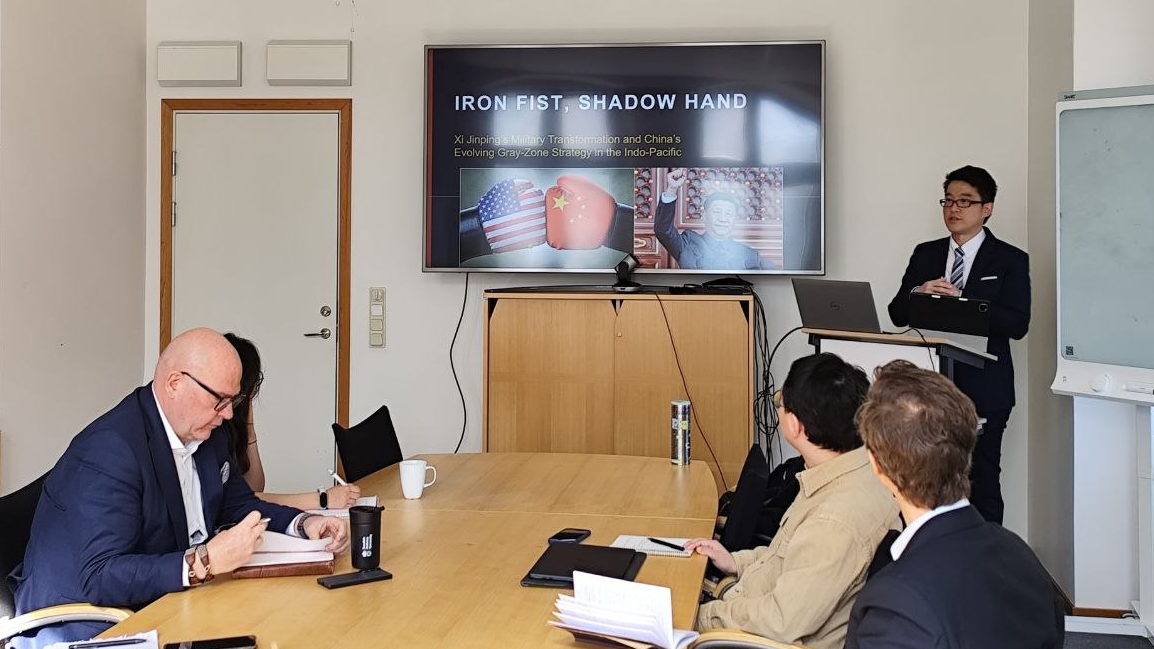
The Stockholm Taiwan Center organized a roundtable discussion on “Xi Jinping’s Military Transformation and China’s Evolving Gray-Zone Strategy in the Indo-Pacific.”
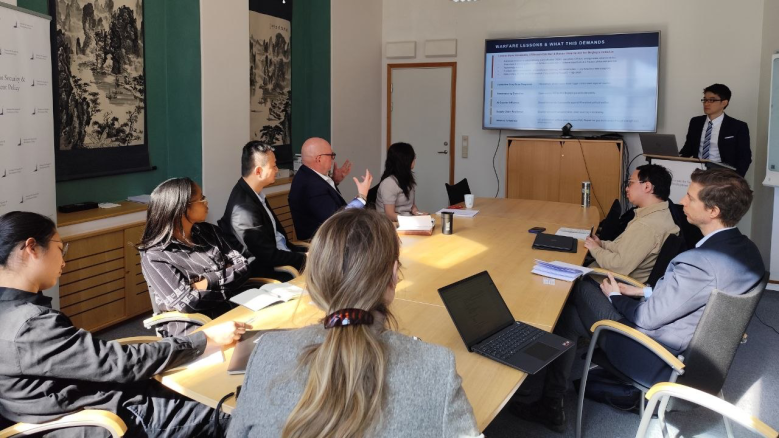
On April 9th, the Stockholm Taiwan Center organized a roundtable discussion on “Xi Jinping’s Military Transformation and China’s Evolving Gray-Zone Strategy in the Indo-Pacific.” The discussion was joined by ISDP research staff along with experts from Stockholm’s academia and policy research community.
During the roundtable, ISDP’s Visiting Fellow Dr. Chia-Chien Chang, an Assistant Professor of the International Master’s Program of International Studies (IMPIS), National Chengchi University, presented his research findings connecting five important developments and their implications: (1) Xi Jinping’s recent purges of senior PLA leaders and what they suggest about command-control incentives, reliability, and risk-taking; (2) evolving gray-zone tactics directed at Taiwan and Japan, including maritime pressure and selective economic coercion; (3) the emerging “AI dimension” of political warfare with the use of generative AI; (4) the signaling function of the September 3, 2025 military parade within China’s broader coercive narrative; and (5) how Beijing may interpret recent U.S. operations in Venezuela and Iran as indicators of American escalation thresholds — shaping China’s own gray-zone calculus.