
ISDP-TSE Conference on Development-Security Nexus in Semiconductors
Key points:
- Self-reliance has its limits: Semiconductor resilience cannot be achieved through national self-sufficiency alone. Countries must balance domestic capabilities with cross-border interdependence and carefully diversify supply chains.
- Industrial policy must build long-term capabilities: Taiwan, Japan, South Korea, China, and Sweden offer different approaches to semiconductor development. Effective strategies require sustained investment, market demand, and stronger links between research, manufacturing, and practical applications.
- Countries need to build on their distinctive strengths: Rather than replicating Taiwan’s semiconductor ecosystem, European countries should identify complementary strengths and secure strategic positions within global supply chains through specialization and international partnerships.
- Europe–East Asia cooperation is increasingly important: Amid rising geopolitical uncertainty, closer cooperation between Europe and East Asia can strengthen supply chain resilience, support innovation, and advance shared economic security objectives.
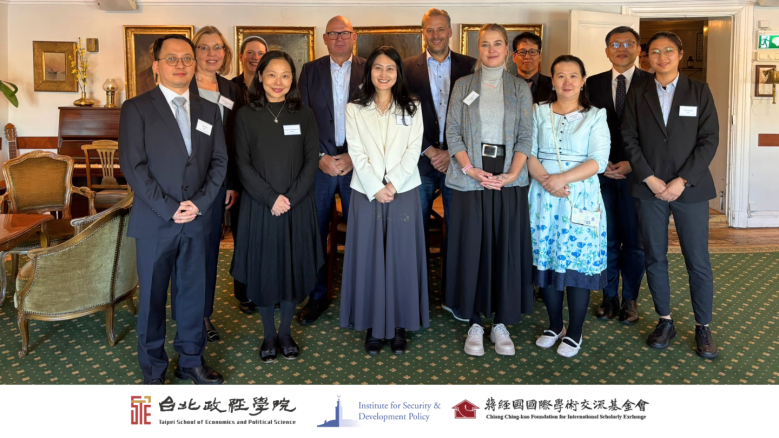
On October 7, 2026, the Institute for Security & Development Policy (ISDP) and the Taipei School of Economics and Political Science (TSE) jointly hosted a conference in Stockholm titled “Development-Security Nexus in Semiconductors: Prospects for Europe-East Asian Collaboration in an Uncertain Era”. This conference was funded by the Chiang Ching-Kuo Foundation.
Given the essential role semiconductors play in modern society, the growing attention to semiconductor supply chains since the COVID-19 pandemic, and projections that the semiconductor market will more than double by 2030, the conference addressed increasingly important questions surrounding the industry’s future.
Bringing together scholars and experts from Taiwan, South Korea, Japan, Sweden, Germany, the Netherlands, and the Czech Republic, the conference provided a platform for international exchange on the challenges and opportunities for Europe–East Asia collaboration in the semiconductor sector amid a changing geopolitical landscape.
Across three sessions, participants explored the tensions between national self-reliance and cross-border interdependence, different approaches to industrial policy and economic development, and the challenges of maintaining global competitiveness, industrial security, and supply chain resilience.
The three sessions highlighted the importance of semiconductor ecosystems, market demand, and innovation. While replicating Taiwan’s semiconductor ecosystem has been discussed in Europe as a pathway toward greater self-sufficiency, achieving this goal has proven challenging. Panelists emphasized the need for companies to respond to market demand and sustain continuous innovation, while acknowledging the risks faced by pioneers in the semiconductor industry. They also stressed the importance of state support in fostering innovation and strengthening the links between research, manufacturing, and practical applications. Ultimately, a key takeaway was that countries should identify and develop their distinctive strengths to secure indispensable positions within the global semiconductor supply chain.
Special Remarks
The conference began with welcome remarks from Niklas Swanström, Executive Director of the ISDP, as well as special introductory remarks from Yves Tiberghien, Dean and Distinguished Professor, TSE. Their remarks highlighted the importance of international cooperation, the growing significance of economic security in the times of a changing liberal order, and Taiwan’s critical role in the global semiconductor industry and supply chains.
Self-Reliance or Deepening Cross-Border Interdependence in Focus
How far should self-reliance go? The presentations of the first panel presented different strategies and views from Japan, Taiwan, and South Korea, as well as a discussion of the limits of economic statecraft in the semiconductor industry.
Moderated by Yifei Zhu, Research Fellow at ISDP, the first panel consisted of Ming-chin Monique Chu, Associate Professor in Chinese Politics, Department of Politics and International Relations, University of Southampton, Kazuto Suzuki, Professor, Graduate School of Public Policy, University of Tokyo; Director, Institute of Geoeconomics, International House of Japan, Shin-Hui Chen, Associate Research Fellow, Chung-Hua Institution for Economic Research, and Sunkung Choi, Assistant Professor of Global Economics and Management, Faculty of Economics & Business, University of Groningen.
Speakers highlighted the limits of economic statecraft in achieving semiconductor self-reliance. In Taiwan’s case, economic statecraft can foster industrial clustering, but it cannot eliminate dependencies on external factors or international supply chains.
For Europe, Taiwan’s semiconductor supply chains remain strategically important. Rather than relocating entire supply chains, speakers suggested that resilience could be strengthened through selective adjustments to production capacity and a gradual, staged approach to diversification.
Japan’s semiconductor strategy, meanwhile, should draw lessons from past experiences by prioritizing global competitiveness over domestic competition among Japanese firms.
For South Korea, maintaining and developing domestic technological capabilities is essential to sustaining long-term competitiveness. Rather than focusing solely on global revenue, South Korea must also strengthen its domestic industrial foundations while maintaining beneficial connections to international markets.
Industrial Policy and Global Competitiveness: Challenges and Opportunities for Europe and East-Asia:
The second panel, moderated by Yi-Chieh Chen, Research Fellow at ISDP, focused on industrial policies and global development. During their discussion, the speakers included Chung-min Tsai, Professor, Department of Political Science, National Chengchi University, Jun Akabane, Professor, Department of Economics, Chuo University, and Elisabet Österlund, Secretary General, Swedish Electronics Trade Association; Project Manager, Semiconductor Sweden, highlighted practical examples from China, Japan, and Sweden.
For China’s semiconductor industry, a central challenge of technonationalism lies in the tension between nationally oriented industrial policies and a highly integrated, transnationally organized technological system. Although state support has helped expand domestic production capacity, strengthening technological capabilities and achieving greater technological autonomy remain significant challenges.
In Japan’s case, the presentation emphasized that Rapidus’s success depends on its integration into the broader Japanese industrial ecosystem, supported by industrial policy, government procurement, and joint development, rather than an approach centered solely on Rapidus itself.
Sweden recognizes the importance of semiconductors for its economic development and sees opportunities to create value through complementary strengths and closer cooperation with Taiwan. Rather than seeking to replicate the entire semiconductor ecosystem, Sweden can strengthen its position by building on its existing technological strengths and fostering international partnerships that connect research and innovation with industrial development.
Challenges and Strengths in Industrial Security and Supply Chain Resilience: Beyond Taiwan’s Silicon Shield, East Asia, and Europe
During the third and final session of the conference, moderated by Niklas Swanström, panelists discussed the strengths of industrial security and cooperation. The panel consisted of Markus Taube, Professor, Chair for East Asian Economic Studies/China, Mercator School of Management, University of Duisburg-Essen, Klára Hurychová, Assistant Professor, Department of Business Law, Faculty of Law, Charles University, and Björn Samel, Vice President Emerging Hardware Technologies, RISE Research Institutes of Sweden.
In order to cooperate with Asian companies, the EU might have to reassess its sustainability initiatives. Cooperation with third-country suppliers should be a condition for compliance, not an afterthought. Due diligence is not only a compliance cost; it also helps map supply chain vulnerabilities and serves as a tool for resilience.
Europe is transforming from a free-trading actor focused on economic opportunities into a security-minded geopolitical player. This opens up new possibilities for future Europe–Taiwan relations. The EU is now willing to accept collateral damage to its relations with mainland China and the United States in order to strengthen its comprehensive security and strategic independence.
Europe and Taiwan have different strengths in the semiconductor industry. However, they share a common focus on developing long-term capabilities. Taiwan’s greatest strength lies in its manufacturing platform, while Europe has excellent research capabilities but faces the challenge of turning good ideas into large companies and keeping them in the Europe.
Overall, the conference highlighted that semiconductor resilience and competitiveness depend not on self-reliance alone, but on a careful balance between domestic capabilities and international cooperation. In an increasingly uncertain geopolitical environment, closer Europe–East Asia cooperation will be essential to navigating strategic dependencies and strengthening supply chain resilience.
The conference report will be published later this year.