
The Hubris of the High-End: Why the West is Failing the Shahed Test
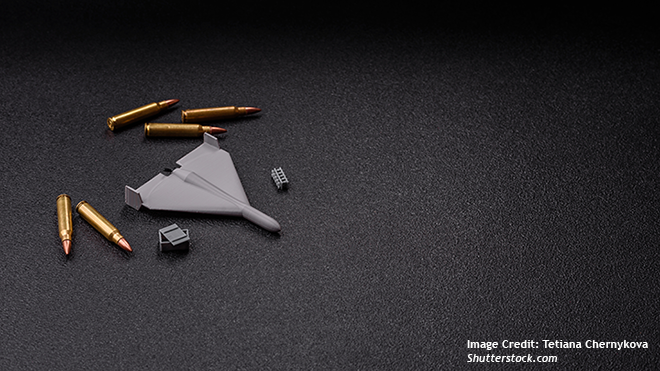
On the morning of February 28, 2026, an impact in Jordan provided a sobering demonstration of how the cost-exchange ratio of modern warfare has shifted in favor of the asymmetric actor. A single Iranian one-way attack (OWA) drone, likely a variant of the Shahed family, successfully navigated past layered regional defenses to strike a critical U.S. Army THAAD radar installation. The drone, manufactured for the price of a family car, inflicted approximately $1 billion in damage to one of the most sophisticated surveillance assets in the American inventory. The strike achieved a strategic decapitation of situational awareness across the broader Middle East, proving this was not a failure of technology, but of a paradigm. The U.S. had spent billions protecting the “high-end” from peer-level threats, only to be blinded by a “lawnmower with wings” that cost roughly $30,000.
This incident serves as the definitive “Shahed Test” that the West is currently unprepared for. It is the logical outcome of a “Superiority Trap”, a systemic obsession with exquisite, high-cost, low-volume weapons that has left the world’s most advanced military structurally vulnerable to the rise of affordable precise mass. Decades of socialization as a global technological hegemon have created a military culture that prioritizes prestige platformswhile ignoring the math of attrition. As precise mass, the industrial capacity to deliver highly accurate, strategic strikes at a fraction of the cost of traditional airpower, becomes the new global currency of conflict, the Pentagon is finding that its 20th-century procurement model is alarmingly defenseless against a 21st-century adversary that iterates in weeks rather than decades.
The Cult of the Exquisite: A Structural Obsession
The U.S. military-industrial complex is structurally geared toward the high-end, with procurement cycles measured in decades and budgets dominated by a handful of billion-dollar platforms. This structural bias has created a force that spends less than 0.5 percent of its defense budget onprocuring”precise mass” capabilities like loitering munitions. The result is a dangerous mismatch between threat and defense.While adversaries like Iran and Russia focus on an industrial revolution of “precise mass”, fielding $30,000 Shahed drones that deliver strategic effects at an attritional scale, the United States remains anchored to a high-reliability, multi-million-dollar interceptor paradigm.
Expending a $4 million Patriot interceptor to neutralize a $30,000 Shahed is an exercise in economic self-sabotage; it represents a mathematical trap that systematically hollows out the West’s limited inventory of high-end interceptors. The data from Operation Epic Fury confirms this imbalance: in the first week alone, Iran and its allies launched 1,668 recorded strikes, with drones constituting 71 percent. These drones, primarily Shahed-series OWA systems deployed in large saturation waves, have been used to disrupt civilian and military infrastructure while forcing defenders to expend costly interceptors against low-cost systems. In contrast, Lockheed Martin produced only about 600 Patriot interceptors in 2025—a total that Russia aims to match with its Geran-2 production in less than a week, as it advertises a goal of producing 1,000 units per day. This mismatch is further reinforced by the pre-war strategic reserve of 80,000 drones, which acts as a buffer capable of negating the impact of Allied strikes on identified production centers for weeks. The lack of interceptors presents a stark strategic dilemma; the instant a Shahed drone is launched, the adversary, in many ways, has already secured a strategic victory. The defender is presented with a lose-lose choice, inflict a crushing asymmetric cost on their own limited stockpile through interception or allow the drone to devastate critical logistical hubs.
The Socialization of Superiority: Hubris as a Security Risk
This strategic imbalance is not a mere byproduct of a budgetary oversight; it is protected by a deeply ingrained institutional hubris that spans military and political circles. The material shortage of interceptors is compounded by a persistent belief in Western planning circles that NATO forces will “fight differently” than the attritional model seen in Ukraine. Military planners often argue that Western air supremacy would prevent the very conditions of saturation currently seen in the Gulf or Ukraine, effectively allowing them to ignore the strategic necessity of mass. However, the reality of Operation Epic Fury demonstrates that air dominance is not a binary state, even the most advanced militaries are currently insufficiently prepared for the scale of Iranian and Russian unmanned capabilities. By dismissing Ukrainian expertise as niche or non-transferable, Western institutions are neglecting the transformative technologies that have already fundamentally changed the economics of defense.
Beyond these structural issues lies a deeper cultural problem, the socialization of the U.S. military as an untouchable superpower. This culture fosters a “Not Invented Here” syndrome, an institutional bias that instinctively rejects outside innovation, leading to the dismissal of battle-proven lessons from smaller allies. Nowhere is this clearer than in the U.S. administration’s 2025 dismissal of Ukraine’s offer to share anti-drone technology—the only nation that has proved itself capable of producing and deploying the tens of thousands of drones required to credibly deter a major drone power. Ukraine currently possesses the world’s most extensive and diverse dataset on the operational employment and interception of OWA UAVs, an intelligence asset of immeasurable strategic value. To neglect this wealth of operational learning while adversaries like Iran and Russia institutionalize these very same lessons is more than a policy error; it is the pinnacle of hubris.
The bottom-up innovation ecosystem of Ukraine is not merely an improvised emergency solution; it is a fundamental reconfiguration of the defense-industrial base. By treating interceptor drones, such as the Sting, Octopus, and JEDI Shahed Hunter, as a central pillar of their air-defense capability rather than an experiment, Ukraine has successfully matched cheap threats with cheap counters. These interceptor drones, costing as little as $1,000 to $3,000, have reportedly destroyed more than 70 percent of incoming drones in critical sectors, effectively bending the air-defense cost-exchange ratio back in the defender’s favor. The success of Ukraine’s decentralized network proves that mass can be answered with mass, but only if one is willing to look beyond the prestige platform in favor of industrial-scale iteration.
President Trump’s assertion that the U.S. “knows more about drones than anybody” epitomizes the hubris that has led to the current strategic bottleneck. This sentiment is further underscored by recent remarks from the CEO of Rheinmetall, who publicly dismissed Ukraine’s decentralized drone manufacturing as amateurish. By insisting that combat-effective innovation can only come from traditional prime contractors, Europe’s defense industrial leadership is proving itself equally affected by the “Not-Invented Here” syndrome. Consequently, Western militaries remain stuck in an unsustainable procurement model, guaranteeing they will be outproduced and economically exhausted in any future attritional conflict. By ignoring the real-time lessons from allies currently fighting, Western defense companies are preparing for an obsolete version of warfare, strengthening a dangerous false confidence in their capabilities.
From Piston to Jet: The Shahed Evolution
The greatest danger of this Western false confidence is the assumption that the threat will remain static. While our procurement models stagnate, the architecture of precise mass is undergoing a rapid, lethal evolution. One of the most obvious examples of this can be seen in the failure to adapt to “TEL-hunting” (Transporter-Erector-Launcher). Systems like the Shahed-136 utilize mobile, low-signature launch rails that allow for immediate relocation, rendering them nearly immune to traditional aerial suppression. This creates a strategic stalemate where the only decisive military counter, a large-scale ground campaign, remains politically prohibitive. While Western procurement remains stagnant in this stand-off, the Shahed family has undergone a sophisticated transition into a high-speed strike architecture specifically designed to exploit exquisite blind spots. Incorporating feedback from the authoritarian learning bloc led by Russia, Tehran is refining its tactics based on real-world performance against NATO-standard defenses.
- Shahed-136/Geran-2: The piston-engine foundation is designed for mass saturation; effective despite its relatively slow 185 km/h speed.
- Shahed-238: A turbojet-powered variant, which allows speeds up to 530 km/h, introduces multi-speed attack waves, drastically shortening the reaction window for radar operators.
- Arash-2: A “strategic sibling” with a 250 kg payload and a 2,000 km range. It delivers bomber-level effects against hardened infrastructure, effectively eroding the operational necessity of manned strike aircraft for high-risk missions.
- Shahed-107: A lighter variant used to saturate air defense radars with “noise,” creating openings for more destructive munitions.
Implications for Global Deterrence
The strategic utility of these low-cost systems extends far beyond the tactical disruption of airbases; they have become the primary tools for eroding the psychological foundations of global deterrence. For decades, Western security has relied on “deterrence by denial”, the credible promise that advanced sensors and exquisite interceptors made any attack pointless. The “Shahed Test” has effectively shattered this illusion. When the West publicly demonstrates an inability to adapt its doctrines to the shifting threat profile of modern warfare, particularly by dismissing the strategic counsel of frontline allies who have mastered these new realities, it signals a fundamental systemic weakness that emboldens adversaries.
This crisis of credibility is being rapidly institutionalized by an authoritarian learning bloc, comprised of Iran, Russia, China, and the DPRK. As these actors share data on how to defeat NATO-standard defenses, the threshold for conflict drops globally. Nowhere is this more dangerous than in the Indo-Pacific, where China is already leveraging these lessons to invest in autonomous drone swarms and mothership platforms like the Jiu Tian. These systems are designed to release hundreds of OWA units to saturate traditional defenses, threatening to overwhelm the defensive depth of a carrier’s strike group, effectively neutralizing its power-projection capability. If the West remains too slow or too ignorant to develop counters to these obvious operational problems, it faces a future where its exquisite shield is rendered strategically irrelevant.
Conclusion: The Necessity of a Cultural Pivot
To avoid a permanent strategic bottleneck, Western players must undergo a radical unlearning of their superpower status. They must move away from a culture that views success as something to be bought through expensive contracts and toward one where it is built through rapid iteration and knowledge exchange. This requires not only a structural shift in procurement budgets toward “precise mass” but also a cultural humility that recognizes the necessity of learning from those currently on the front lines. The failure to integrate Ukrainian expertise and the continued reliance on exquisite stagnation are symptoms of a systemic military malaise that leaves the West unprepared for the future of warfare.
Ultimately, the failure to pass the “Shahed test” is not a failure of technology, but a failure of imagination and perception. A recent study by the Hague Centre for Strategic Studies found that part of the reason why Europe was unable to dissuade Russia from invading Ukraine is that European politicians simply could not accept that a war in modern Europe was possible. The same logic now governs how we prepare for future conflict. Just because Western politicians and military planners cannot believe we may have to fight in the same “low-tech” and attritional fashion as Ukraine does not mean it will not happen. It simply means we will be catastrophically unprepared to do so.