
Techno-Strategic Pragmatism: The UAE–Sweden Defense Partnership in Comparative Perspective
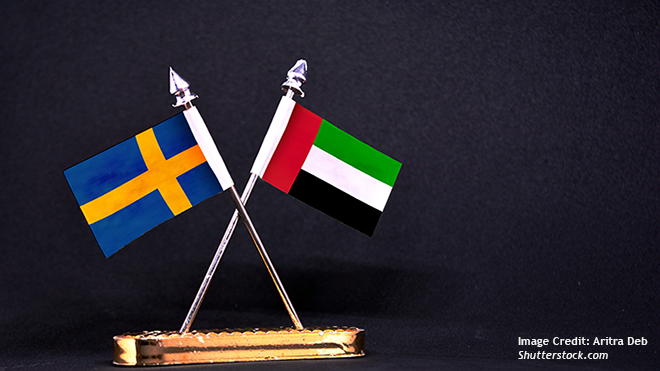
The defense relationship between the United Arab Emirates and Sweden represents a distinctive model of middle-power cooperation in an era defined by supplier diversification, technological acceleration, and geopolitical uncertainty. While it does not command the same political visibility as the UAE’s partnerships with the United States or France, the Sweden track has matured into one of Abu Dhabi’s most consequential high-technology European security relationships. It is anchored in airborne early warning, radar ecosystems, industrial localization, and dual-use resilience technologies—domains that are foundational to modern deterrence but often less publicly visible than fighter jets or missile systems.
The ongoing U.S.–Israel war against Iran and the subsequent wave of Iranian missile, drone, and rocket attacks targeting GCC states, most notably the UAE, have elevated the operational relevance of such enabling capabilities from theoretical assets to frontline necessities. The UAE’s ability to intercept and neutralize incoming projectiles with high efficiency underscores the importance of integrated air and missile defense architectures, in which early warning and sensor fusion systems, many linked to Swedish technology, play a critical, if often understated, role.
What makes the UAE–Sweden relationship strategically noteworthy is not simply the hardware involved, but the structure and logic of the partnership itself. It is a form of techno-strategic pragmatism: capability-driven, industrially embedded, politically calibrated, and largely insulated from alliance politics. In contrast to some of the UAE’s other defense partnerships, particularly with the Republic of Korea (ROK) and Brazil, the Swedish lane reflects a narrower but deeper focus on niche enabling technologies, shaped by Sweden’s democratic norms and export-control guardrails.
Strategic Logic: Diversification, Autonomy, and a European High-Tech Anchor
For the UAE, Sweden fits squarely into a long-standing strategy of supplier diversification. Abu Dhabi has consistently sought to avoid over-reliance on any single power, building instead a multi-vector defense portfolio that includes the United States, France, South Korea, Brazil, and others. Within this mosaic, Sweden occupies a specific European high-technology niche.
At the same time, Sweden’s profile as a technologically sophisticated democracy with a strong R&D culture adds reputational credibility. Unlike larger powers, Sweden does not impose alliance-level political conditionalities on the UAE. As a NATO member with deep European industrial networks, Sweden connects the UAE to advanced Western defense ecosystems. For the UAE, partnership with a NATO-member supplier in critical ISR domains provides indirect alignment with Western operational standards without entering formal alliance commitments. For Sweden, Gulf partnerships extend the strategic footprint of NATO-compatible technologies beyond Europe.
At the political level, the signing of a Memorandum of Understanding in 2025 institutionalizing structured political consultations signalled that the relationship is evolving beyond transactional procurement. Defense cooperation now sits within a broader framework of dialogue and strategic coordination, reinforcing predictability and continuity.
GlobalEye and the Centrality of Enabling Capabilities
The backbone of the relationship is the UAE’s acquisition of five Saab GlobalEye airborne early warning and control aircraft between 2020 and 2024. GlobalEye is not merely a surveillance platform; it is a systems integrator in airborne form. It provides long-range air, maritime, and ground surveillance, enhanced detection of low-flying and complex aerial threats, and real-time data fusion feeding into national air and missile defense networks. The recent Iranian attacks have highlighted the decisive role of such platforms. Early detection of incoming drones and cruise missiles, particularly low-altitude, radar-evading threats, has been a critical factor enabling timely interceptor launches. In this context, GlobalEye’s ability to extend detection ranges and provide real-time situational awareness has likely contributed to the UAE’s high interception success rates, even if such contributions remain classified or publicly understated.
For the UAE, this capability strengthens monitoring of strategic waterways such as the Strait of Hormuz and Gulf approaches, enhances oversight of maritime corridors linked to the Red Sea, and improves resilience against drone and cruise missile attacks. In a region where aerial threats have become faster, more numerous, and technologically diverse, early warning becomes a strategic equalizer.
For Sweden, the UAE has functioned as a globally significant reference customer. The programme has reinforced Saab’s export credibility and validated GlobalEye operationally. The 2024 in-service support contract, valued at approximately USD 190 million over three years, shifted the partnership from acquisition to sustainment. Sustainment deepens defense diplomacy: training pipelines, maintenance ecosystems, and upgrade cycles create long-term interdependence and institutional familiarity.
Industrialization and Co-Production: From Localization to Joint Innovation
One of the most distinctive aspects of the UAE–Sweden relationship is its industrial depth. The creation of Abu Dhabi Advanced Radar Systems (ADARS) as a joint venture between Saab and Tawazun signalled early commitment to localization in a high-value technological domain. Radar development and integration capacity embedded in the UAE represents more than offset compliance; it reflects structured capability transfer. Saab’s development and production footprint at Tawazun Industrial Park further institutionalized this cooperation. Locally developed infrared camera modules and coastal surveillance radars illustrate how Swedish technological expertise is adapted to Gulf operational realities.
Importantly, jointly produced coastal radar systems are now framed not only as domestic assets but as potential export products. This marks a subtle yet significant evolution: from localization for self-reliance toward co-production for third markets. The Gulf and Red Sea littorals, exposed to drone swarms, missile threats, and non-state maritime actors, serve as both operational driver and innovation laboratory. The UAE thus emerges not merely as a recipient of Swedish radar technology, but as a contextual co-developer of systems tailored to hybrid maritime environments.
For Abu Dhabi, this aligns with its ambition to become a regional defense-industrial hub. For Sweden, localization provides long-term industrial scaling while preserving intellectual property core competencies and benefiting from a demanding operational testbed.
Dual-Use Technologies and the Convergence of Resilience Concepts
Beyond conventional defense hardware, cooperation increasingly extends into dual-use domains such as deployable communications networks, air traffic management systems, additive manufacturing, and secure digital infrastructure. This reflects a convergence between Sweden’s “Total Defence” thinking and the UAE’s emphasis on national resilience and infrastructure protection.
More recently, bilateral engagement has expanded into artificial intelligence and renewable energy cooperation. While not defense programmes per se, these initiatives reinforce the technological ecosystem within which security systems operate. AI-driven analytics, predictive maintenance, and automated data fusion are central to next-generation ISR and command-and-control architectures. Embedding defense collaboration within broader AI and sustainability dialogues reflects a shift from siloed procurement toward ecosystem-level technological alignment.
Such integration also enhances political sustainability. Surveillance, resilience, and dual-use technologies are more easily justified within Sweden’s export-control framework than overtly offensive strike systems. The partnership thus evolves within clearly defined normative parameters.
Comparative Perspective: Sweden, South Korea, and Brazil
Placed alongside the UAE’s defense diplomacy with South Korea and Brazil, the distinctiveness of the Swedish track becomes clearer. The UAE–ROK relationship has been characterized by large-scale air and missile defense procurement, most notably the multi-billion-dollar Cheongung II (M-SAM) interceptor deal. The Korean partnership is more platform-centric and strategically packaged, embedded within broader state-to-state economic and industrial cooperation. While South Korea is also a democracy, its defense export debates operate under different domestic political dynamics, allowing for more visible expansion into missile defense architectures. The current conflict has demonstrated the complementary nature of these partnerships: while Korean and U.S.-supplied interceptor systems provide the kinetic layer of defense, Swedish-enabled ISR capabilities ensure that these systems are effectively cued, coordinated, and deployed.
The Brazil relationship represents yet another model. Cooperation with Brazilian firms such as SIATT, particularly in anti-ship missile development, leans toward co-development and intellectual property collaboration, supporting the UAE’s ambitions through EDGE to expand its export portfolio. Brazil provides industrial flexibility and South-South collaboration pathways less constrained by European export-control structures. Sweden, by contrast, contributes enabling systems such as early warning, radar, and sensor fusion, rather than interceptor-centric missile defense or co-developed strike systems. The Swedish lane thus strengthens the UAE’s defensive backbone and technological resilience, complementing rather than duplicating other partnerships.
Mutual Strategic Gains and Economic Statecraft
For the UAE, Sweden enhances strategic diversification, strengthens ISR capacity, and deepens defense industrialization in advanced sensor domains. It also reinforces Abu Dhabi’s credibility as a technologically sophisticated security actor capable of contextual adaptation and co-development.
For Sweden, the UAE provides revenue stability and operational validation for export-dependent high-technology defense production. The relationship also reflects economic statecraft. As European defense budgets expand and competition intensifies, maintaining diversified export markets becomes critical for sustaining industrial capacity. The UAE, with its procurement agility and capital resources, serves as a high-value non-European anchor market. In this sense, defense diplomacy intersects with industrial competitiveness and national economic strategy on both sides.
A Calibrated European Pillar in the UAE’s Security Architecture
The UAE–Sweden defense partnership demonstrates that security cooperation need not be alliance-based to be strategically meaningful. It is a calibrated, technology-driven relationship that reinforces surveillance, resilience, and deterrence without escalating into overt political alignment. Compared to the platform-heavy South Korean relationship and the co-development-oriented Brazilian track, the Swedish lane stands out for its focus on enabling technologies, industrial depth, and normative predictability. It embodies techno-strategic pragmatism with guardrails: deep enough to matter, structured enough to endure, and constrained enough to remain politically sustainable.
Within the UAE’s broader foreign policy, defined by diversification, technological modernization, and calibrated deterrence, Sweden occupies a trusted, high-tech European partner role. In a region shaped by complex aerial threats, hybrid maritime risks, and infrastructure vulnerability, such enabling capabilities may ultimately prove as strategically decisive as more visible offensive acquisitions.