
The JAUKUS Option Revisited: Will Japan Join AUKUS under the Takaichi Administration?
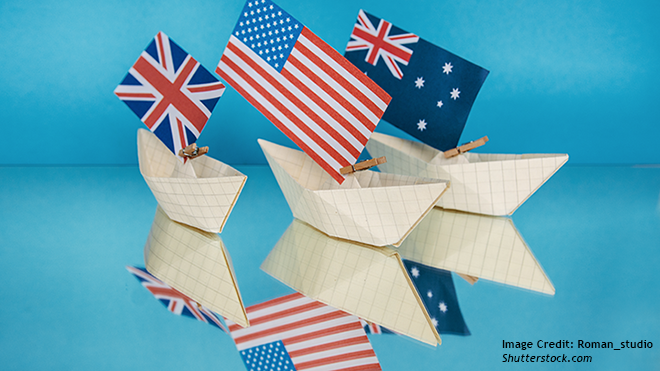
As a key U.S. ally, Japan has been slowly but naturally involved in a trilateral security partnership between Australia, the United Kingdom, and the United States (AUKUS) in recent years. The AUKUS partnership was established in September 2021 by the three countries to support a free and open Indo-Pacific.
Although it is not a formal military alliance, AUKUS aims to strengthen the advanced military capabilities of the member-states and enhance deterrence in the Indo-Pacific with two pillars. Pillar I involves the supply of nuclear-powered conventional attack submarines (SSN) to Australia by the 2040s. Pillar II intends to facilitate advanced technology cooperation, including undersea capabilities, quantum science, artificial intelligence (AI) and autonomy, advanced cyber, hypersonics and counter-hypersonics, and electronic warfare.
Japan’s Expanding Role in AUKUS and Minilateral Frameworks
Notably, it was reported that the U.S. State Department has expected Japan’s role in the AUKUS partnership, and the Japanese government has expressed its willingness and begun to participate in Pillar II.
Other than AUKUS, Japan has already been embedded in multilateral defense partnerships on the basis of the Japan-U.S. alliance. The origin of the Trilateral Strategic Dialogue (TSD) among Japan, Australia, and the United States, dates back to as early as 2001, and the TSD has been complemented by Trilateral Defense Ministers Meetings (TDMM). It has been observed that the TSD is the most underrated minilateral and has to be revitalized for regional stability in the Indo-Pacific. Given Japan’s commitment to the TSD, it is natural for Japan to cooperate with AUKUS member-states, especially for Pillar II. The TDMM joint statement expressed on November 16, 2024, welcomed “progress on Japan’s consultation with AUKUS partners under AUKUS Pillar II, with the initial focus to improve interoperability with Japan’s maritime autonomous systems” and “Japan’s October 2024 participation as an observer in Exercise AUTONOMOUS WARRIOR under the AUKUS Pillar II Maritime Big Play series, an important step”. In other words, the TSD and the AUKUS can be regarded as mutually supplemental security partnerships in the Indo-Pacific region.
Likewise, Japan has been part of another minilateral security dialogue with Australia, India, and the United States, known as Quadrilateral Security Dialogue (Quad). The Quad was proposed by former Japanese Prime Minister Shinzo Abe in 2006, and was established in May 2007. Although Quad 1.0 collapsed because of the sudden resignation of former Prime Minister Abe in 2007 and Australia’s policy toward Beijing during the Kevin Rudd administration, the quadrilateral defense partnership developed into Quad 2.0 in 2017.
After the outbreak of the 2022 Russia-Ukraine War, some analysts have discussed the emergence of Quad 3.0, in which Japan would be able to possess and utilize counterstrike capabilities for self-defense. Furthermore, the Quad has collaborated with other partner countries, forming the so-called Quad Plus framework in the Indo-Pacific. Given the previous defense collaboration within the TSD and the Quad, it is natural for casual observers to assume that Japan would join the AUKUS framework, forming JAUKUS, although the feasibility has been unrealistic so far.
Debating JAUKUS: Political Support and Strategic Rationale
In addition to these conventional minilateral security partnerships, some politicians, policymakers, and researchers have considered Japan’s participation in the AUKUS framework. In the face of the establishment of AUKUS, Shingo Yamagami, serving as Ambassador to Australia, commented that “we have been told there are some instances or areas where AUKUS members may need Japanese cooperation and participation and we are more than willing to do our contribution”. On November 13, 2023, former Japanese Prime Minister Taro Aso mentioned that “I would like to propose an ambitious idea… How about we expand AUKUS to include Japan, making it JAUKUS?” at the Australian Institute of International Affairs in Canberra. Aso’s proposal to establish JAUKUS itself must be regarded as a political rhetoric to signal opposition to a change of Taiwan’s status by the Chinese military forces.
Some experts, such as Michael Auslin, support Japan’s participation in AUKUS, forming a geopolitically influential framework in the Indo-Pacific. Rena Sasaki contended that it is important to accelerate discussions on Japan’s participation in AUKUS. She pointed out that if Japan joins AUKUS, Japanese defense industries would be internationalized and reinvigorated. Likewise, Hirohito Ogi, a senior research fellow at the Asia Pacific Initiative and the Institute of Geoeconomics (IOG), the International House of Japan (IHJ), argued that the JAUKUS framework would enhance the undersea deterrence capabilities of the member-states, which could degrade Chinese maritime forces. Thus, it seems that there are positive opinions on Japan’s participation in the AUKUS partnership.
At the same time, however, there have been negative opinions on the JAUKUS option. Although Japanese Prime Minister Fumio Kishida upgraded the Japan-Australia special strategic partnership by signing the Reciprocal Access Agreement (RAA) in January 2022, he was cautious about formally joining the AUKUS framework because it was considered that the acquisition of nuclear-powered submarines would violate the Atomic Energy Law.
As reported in Reuters on April 9, 2024, Australian Prime Minister Anthony Albanese mentioned that there is no plan to add a fourth member to AUKUS, although he praised Japan as a close partner of the trilateral defense partnership. In concrete terms, Japan lacks effective counter-espionage laws unlike AUKUS member-states, and hence, Japan is not ready to participate in AUKUS yet.
Michito Tsuruoka, a professor at Keio University, also stressed that AUKUS would not become JAUKUS in the foreseeable future, because Japan’s security information standard is not compatible with AUKUS member-states, and the “level of trust needed to share the most secret and sensitive technologies cannot be achieved overnight”. Tsuruoka warned that it is important to continue a more precise discussion on Japan’s cooperation with AUKUS despite the burgeoning political rhetoric. Similarly, Aurelia George Mulgan, a professor at the University of New South Wales, made a critical comment that Aso’s views on JAUKUS are “far from reflecting a consensus in his own party” and, therefore, JAUKUS is not a politically viable option in Japan.
Domestic Political Change and the Future Possibility of JAUKUS
The establishment of JAUKUS has been politically unrealistic during the Kishida and Ishiba governments. However, the administration of Prime Minister Sanae Takaichi, in coalition with Nippon Ishin no Kai (Japan Innovation Party), would facilitate Japan’s collaboration with AUKUS even more than previous administrations. The Liberal Democratic Party (LDP) led by Takaichi, literally swallowed the demands by Nippon Ishin no Kai based on its hardline policies, including its hawkish foreign and security policy. Notably, the LDP agreed on Ishin’s demand for promoting the introduction of nuclear-powered submarines as next-generation propulsion systems equipped with a vertical launching system (VLS) for long-range missiles. Japan’s acquisition of nuclear-powered submarines is compatible with Pillar I of AUKUS.
Regarding this issue, Defense Minister Shinjiro Koizumi made a supportive comment that “the environment surrounding Japan is so severe that we have to discuss whether to use diesel as we’ve done so far or nuclear power”. Still, it is important to note that Koizumi’s remark on the possession of nuclear-powered submarines followed U.S. President Donald Trump’s approval for South Korea to build its own nuclear-powered submarines, rather than pursuing the JAUKUS option.
As a result of the snap election of February 2026, Takaichi’s LDP won a two-thirds majority in the Lower House. Another two-thirds majority in the Upper House is necessary for Takaichi to succeed in constitutional revision, but it is theoretically possible for Takaichi to conduct constitutional revision if Nippon Ishin no Kai, the Democratic Party for the People, Sanseito, the Japan Conservative Party, and a few votes from independents would suffice to secure a two-thirds majority in the Upper House. Therefore, it is possible to consider that Takaichi would take action toward constitutional revision with a view to normalizing and enhancing Japan’s defense capabilities.
By constitutional revision, the Self-Defense Forces (SDF) would be stipulated in the Japanese Constitution, and defense capabilities could be considerably upgraded. In such a scenario, the SDF would be able to enhance interoperability with the military forces of the AUKUS member-states, and finally, the creation of JAUKUS might be a politically viable option in Japan if the Takaichi government succeeds in military normalization through constitutional revision.